The Colonel Richard Gimbel Aeronautical History Collection

Prints  1779 – 1802


Narration By Will Ketterson

Introduction By Paul Maravelas

Colonel Gimbel began to amass his aeronautical collection during World War II, a decade after author Lockwood Marsh had lamented that early aeronautical prints were becoming difficult to find. Yet Gimbel was able to assemble an unsurpassed private collection of images, including one important print (Vuë d'Annonay en Vivarais), which I believe is one of two copies in the United States.  At the end of his life Gimbel owned approximately 2,000 prints, which he organized into about 40 groups according to theme. Aside from a handful of prints that were framed and exhibited in Gimbel's New Haven home, the collection was kept in semi-rigid boxes.

Such an extensive archive allows one to compare a variety of illustrations that depict a single aeronautical event; one soon concludes that we cannot view these prints literally. The variations are not surprising when we reflect that a commercial medium was used to generate commemorative images of scenes that were often momentary or, in fact, had yet to occur; in either case they presented particular challenges to the artist

Flight, throughout its history, appeared to be less promising to some people than to others, and one sees (especially in the eighteenth century) a large number of satirical prints in which the balloon is used to symbolize folly or the balloon itself is characterized as the contrivance of misguided enthusiasts. The subject is well addressed in Melvin Waldfogel, François-Louis Bruel (De Vinck), and by Burkhard Leismann in a chapter of Leichter als Luft.  Without ignoring this phenomenon altogether, I have selected largely from the prints produced for aeronautical enthusiasts. I have tried to emphasize in the text the perspective of the audience for which the prints were intended, with the hope that we might consider how these prints were regarded by those who first enjoyed them.

*   *   *

Measurements of the prints are given in centimeters measured from the edges of the plate with intaglio prints and the edges of the images for others. In the descriptions the wording is recorded as it appears on the prints, incorporating the irregular spellings and apparent disregard for accents sometimes found on the originals. Many of the artisans or artists who created these works could not be located in documentary sources, and their names appear simply as given on the prints. The publishers are indicated only when their prominence or association with the world of aeronautics seemed to dictate it. The numbering system maintained in the Gimbel collection (the “X” number identifying each print) is based on Gimbel's grouping. Finally, the full citations to the catalogues and other works (e.g., Bruel, Caproni, George, Leichter als Luft, Liebmann and Wahl, March) mentioned in the descriptions are included in the “Prints” section of the Bibliography of this program.



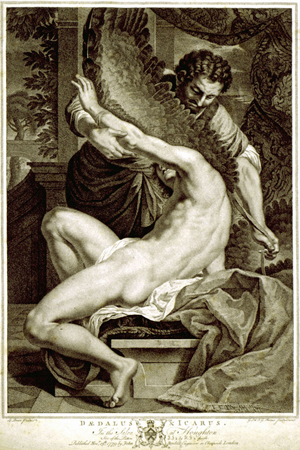
Dædalus & Icarus, in the Salon at Houghton

Johan Gottlieb Facius & George Sigmund Facius, after Charles Le Brun  (1619-1690)
Etching, stipple engraving, 27.5 x 40 cm.
XP-XL-1 (1018)

Charles Le Brun profoundly influenced French art while serving in various official positions, including first painter to Louis XIV. Le Brun's "Dædalus & Icarus," which measures over 4 x 6 feet, shows the mythological pair preparing their escape from the Island of Crete, where they were imprisoned for offending King Minos. Icarus and Dædalus fashioned wings for the escape, but Icarus flew too near the sun (which melted the wax that held the wings together) and fell into the sea. The myth suggests the importance of remembering one's place in the cosmos; the painting emphasizes fatherly dedication and the recklessness of youth. Most of Le Brun's paintings were published as engravings. At the time this print appeared (November 1779), Le Brun's painting was part of the collection at Houghton Hall in Norfolk, England, which had been built between 1722 and 1735 by Sir Robert Walpole. After Sir Robert's death in 1745 the house passed in succession to two sons who let Houghton Hall deteriorate. A third son, the famous Horace, noted in 1773 that the house was "half a ruin, though the pictures, the glorious pictures, and furniture were in general admirably well preserved." The painting is now in the Hermitage, St. Petersburg.

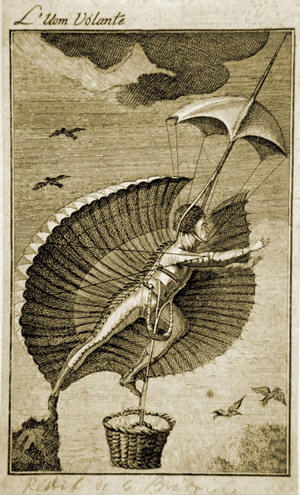
L'Uom Volante

[After 1781].
Etching, sheet trimmed to 8.2 x 14.3 cm.
XP-XL-27 (2223)

This design formed the frontispiece to a fantasy in four volumes: La Découverte australe par un homme volant written by Restif de la Bretonne and published in Leipzig and Paris in 1781. The parachute-like device strapped to the flyer's head is an intriguing innovation, as the print appeared years before the parachute was developed. (This is a copy of the original; in the original, the figure faces left.)


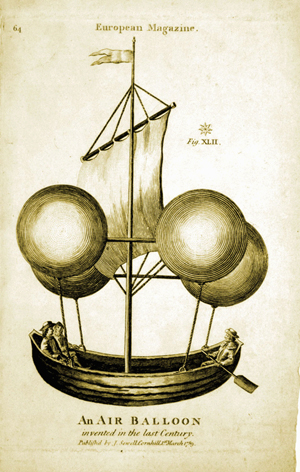
An Air Balloon invented in the last Century

London, 1789.
Etching, 18.6 x 12.3 cm.
XB-8-3B (1052)

This etching pictures the aircraft designed by Francesco Lana de Terzi, which incorporated four copper spheres devoid of air. Originally published in 1670, this articulation of the aerostat was the earliest we know of, although it was never built and it appears that since the spheres would need to resist the pressure of the atmosphere, they would be too heavy to float in the air. Although Lana's concept had no direct effect on the invention of the balloon, his craft received a new bout of publicity when the balloon was introduced in 1783. It would appear that the English, however, were not paying very close attention, as this plate appeared in European Magazine and London Review in February 1789, six years after similar images had been exhumed and published in France and four years after Tiberius Cavallo had devoted several pages to it in his History and Practice of Aerostation, published in London. The two-page article that accompanies this plate in European Magazine begins: "A correspondent has obliged us with the following quotation from a scarce book, incontrovertibly proving that the subject of BALLOONS had been investigated long before the FRENCH AERONAUTS and LUNARDI entertained the public with the practical succession of these useless phænomenon." The article consists of passages from Johannes Sturmis' Collegium Experimentale, a book that presented, in 1701, the idea of Lana's aerostat without acknowledging the source. (An exact predecessor of this print was published [in reverse] in Michael Bernhard Valentini's Museum Museorum, Th. 3 tab. xxvii, Frankfurt am Main, 1714.)


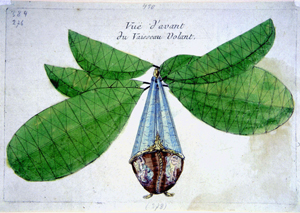
Vuë d'avant du Vaisseau Volant

Etching, 23.8 x 16 cm.
XP-XL-6 (1214)


Jean-Pierre Blanchard constructed this ornithopter in 1782 and promised to fly it in May of that year. The attempt was postponed because of rain, and despite continuous promises, it never occurred. Blanchard's reputation suffered greatly. This print forms a part of a series of four images illustrating the machine, which used a series of pulleys and ropes operated by the pilot with his arms and legs. (The print is a copy of the original series of four views published by Françis-Nicholas Martinet, probably issued after Blanchard began his career as a balloonist in 1784.)


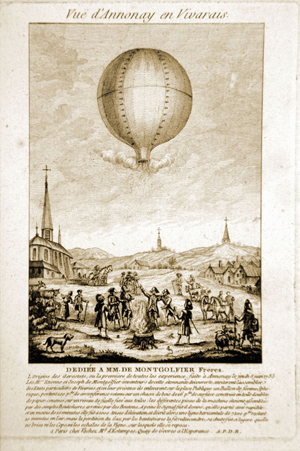
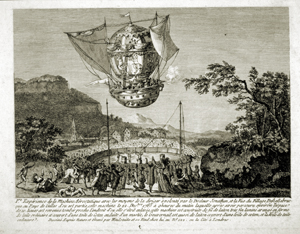
Vuë d'Annonay en Vivarais. Dediée a MM. de Montgolfier Frères

Paris, [1785?]. Chez [Le] Vachez.
Etching, 15 x 10.3 cm.
XC-10-2M (2878)

This small print supposedly depicts the first public launch of a balloon by Joseph and Étienne Montgolfier in June 1783 before an audience of the regional government, Les États particuliers de Vivarais. Several features signal that this depiction is inexact. The desolation of the surroundings is especially odd since this launch took place in the middle of a modest town before a multitude of people. It is improbable that a hot-air balloon would possess so fine a mouth, and there is no depiction of what Étienne Montgolfier described as a "carriage" below the envelope. The print does depict the method of fastening the parts of the balloon together, which involved the use of buttons. According to the caption this method allowed the balloon to be rapidly assembled, presumably so that the Montgolfiers could transport the paper and canvas aircraft in parts. The many lines around the envelope may be meant to depict the net mentioned in the caption. The date of this print's appearance is curious, for one would presume it to be some time proximal to the event depicted; instead, the print was announced in the Journal de Paris on December 26, 1784, although the plate had yet to be prepared. No other eighteenth-century depiction exists of this first public display, although later artists address the event.  The print shown here was widely copied in the nineteenth century. The print has been attributed to P.G. Tavenard by Liebmann Wahl (#175), and to Nicolas de Launay (engraver) and Étienne Chevalier de Lorimier (artist) by Marsh; no artist's marks appear on the print. 

(This is probably the rarest aeronautical print known, and the Gimbel copy is thought to be one of two examples in the United States. It was issued as part of a series of prints by Nicolas-Françis Le Vachez, all of which were schematically similar and the same size; the series included XC-10-2C 3390, "Vue de la prarie de Nesle, situé à 9 lieus de Paris"; XC-10-2M 2882, "Vue de Versaille, pris du coté de la çhapelle"; XC-10-2M 2893, "Vue de la Terrasse de Mr. Franklin à Passi"; and XL-6 4622, "Vue du Château de Douvres."  The Journal de Paris of October 8, 1784, mentions the series, "all five and a half inches in height and four wide," for sale at 12 sous colored and 8 plain. The series was reported to be complete with the publication of a print depicting  the "third trial of the Robert Brothers . . . on the 29th ofSeptember," which had already been issued in a larger format [print XP-XL-4 1159].  On the 26th of December, 1784, two additional prints were announced.  Mondin identifies nineteen prints in the series. The Tissandier collection in the Library of Congress in Washington, D.C., holds a copy of the "Vue d'Annonay" bound into a rare [and possibly unique] collection of fifteen of the prints titled: Suite complète des estampes représentant les expériences aérostatiques, undated, with the imprint: "A Paris, Chez le Vachez.")


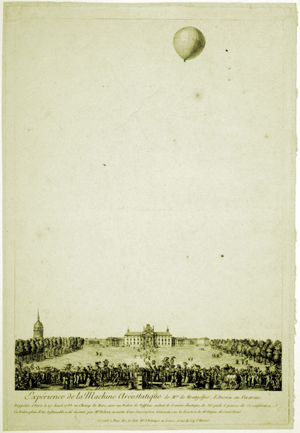
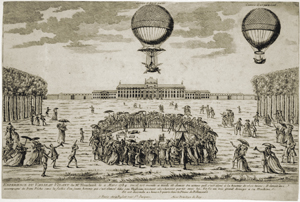
Expérience de la Machine Aréostatique de Mrs. De Montgolfier, d'Anonai en Vivarais. Reppetée  à Paris le 27 Aoust 1783 au Champ de Mars.

Paris, [1783?]. Chez Le Noir. 
Engraving, 27.2 x 40 cm.
XP-XL-3 (1100)

The small fabric balloon that was launched on August 27 from the Champ de Mars was intended to repeat the demonstration in Annonay and introduce the balloon to the French capital. Faujas de Saint-Fond, a geologist, was responsible for raising the money for the 36-foot balloon; physicist J.A.C. Charles was responsible for its design and launch; and the Robert brothers built it. Charles could assume that the Montgolfiers had used hydrogen for their Annonay balloon or at least that hydrogen would work well for the purpose of repeating the Annonay trial. This print is famous for its recycled foreground: As historian François-Louis Bruel first pointed out, the plate had previously been used for the print "Aux incrédules de Paris," a satirical treatment of Blanchard's "flying machine" over Paris. There are two states of the "balloon" version, with differences in the foreground and middle ground to more accurately reflect the circumstances of the launch. In this version, the valve is still attached to the mouth of the balloon, whose small size (or closed position) caused the explosion of this balloon in flight. 

(This is the "third state" of the plate, published by Le Noir, showing new environs but retaining some of the foreground figures. The print was quickly ready for distribution, since parts of the plate existed as explained above; the Journal de Paris announced publication on August 29; the price was 12 sous. Benjamin Franklin mentions the print by title in a September 2 postscript to a letter of August 30, addressed to Sir Joseph Banks. Franklin noted that, in the caption of the print, Faujas de Saint-Fond had been credited with the organization of a national subscription in support of the balloon and that Charles had been added as an organizer, although his name "is wrote with pen, not engraved." Aside from Franklin's mention, the author has not noted this addition on any other copies of the print. Le Noir, whose first name is not known, was either the father or the brother of the engraver Rose Le Noir, who engraved print XL-41 3237.)


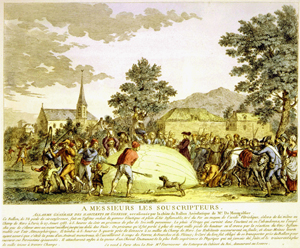
A messieurs les souscripteurs.  Allarme général des habitants de Gonesse

Paris, [1783?]. Chez Le Noir.
Etching, 31.4 x 21.4 cm.
XP-XL-3 (1101)


Issued by Le Noir, this intriguing plate suggests the ignorance of the provincials, who were reportedly so alarmed by the balloon as it descended on August 27 near the village of Gonesse that they destroyed it. As the caption states, 300,000 Parisians had watched the balloon launch 45 minutes prior to this scene; the reaction of the provincials illustrates the lack of communication and the disparity of technologies at the time. The same device could enlighten the people of one city and cause panic in a village 12 miles away. This print was clearly intended for the upper classes of Paris and was sold by "Le Noir, M[archan]d Fournisseur des Estampes du Cabinet du Roi, demeurant au Louvre" (Le Noir, merchant and purveyor of prints to the Cabinet of the King, residing at the Louvre). We can contrast it to many other satirical prints of the balloon that were intended for the general public. (The Gimbel collection includes five different prints of this scene, all schematically similar.)


Expèrience faite à Versailles en presence de S.M. le Roy par le Sieur Montgolfier le 19 Septembre 1783

[After Étienne Chevalier de Lorimier (1759-1813)] 1783?
Painting, with ink details, on paper, 13.1 x 18.2 cm.
XC-10-2M (2884)


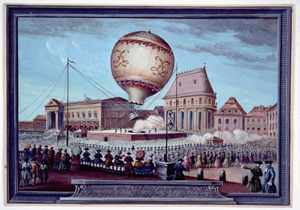
On September 19, 1783, Étienne Montgolfier "proved" the invention before the King of France at Versailles and a multitude of curious Parisians. Unlike the balloon of August 27, this aircraft carried a payload and captivated all of Paris.  This event provided an extremely popular image, and numerous decorated objects feature this scene.(Clément [p.46] shows a similar painting on a box, as does Jackson [p.38]. The Gimbel collection includes two boxes: one [Misc.25] of 7 cm diameter with the image painted on the top and signed by Y. Capelle [1746-1800]; another [Misc.24] shows the launch from a different perspective.)


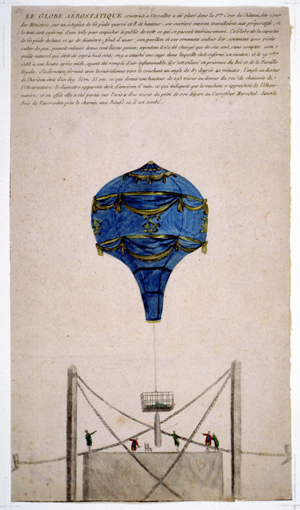
Le globe aërostatique construit à Versailles a été placé dans la 1ere. Cour du Château

Etching, with roulette, 33.7 x 19.2 cm.
XP-XL-2 (1066)


The demonstration on September 19, 1783, not only revealed the workings of the hitherto mysterious hot-air balloon, but established the safety of flight—at least for sheep and fowl. This straightforward version of the ascent ignores the mass of Parisians before whom this invention was unveiled, emphasizing instead the technology involved. The payload included a cage containing three animals, while a long cylinder housing a crude recording barometer is given special prominence by the artist. The print's caption explains that the balloon's lift is 1,200 pounds, its size is 60 feet high by 40 feet wide, and its coloration is gold detail on a blue background. "About 100 workers helped to ready it, and the whole area was enclosed with canvas to prevent the public from seeing what went on inside." This caution was typical of the Montgolfiers, and in fact the caption erroneously reports that this hot-air balloon was inflated with "inflammable air."  Close examination of this print reveals what appear to be buttons along the seams, which suggests the repetition of the technique used in the balloon of June 5, shown in print XC-10-2M 2878. (An English version, "The Original Air Balloon" [XC-10-2M 2903], is a direct copy of this print.)


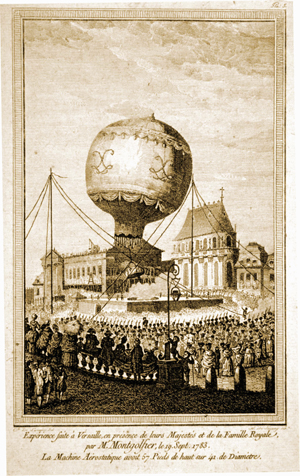
Expérience faite à Versaille, en présence de leurs Majestés et de la Famille Royalle, par M. Montgolfier, le 19. Sept.1783

Nicolas De Launay (1739-1792), after a design by the Chevalier de Lorimier (1759-1813) Paris, [1783].
Etching, 15.5 x 10 cm.
XC-10-2M (2880)


This masterful sketch of the September 19 ascent of a sheep, cock, and duck appeared as the frontispiece in the Description des expériences aérostatiques by Faujas de Saint-Fond. The nine prints in the book are known for their accuracy as well as their beauty; in fact, the creators of the work boasted of its precise descriptions, which were created at the events. Twenty-four-year-old Étienne Chevalier de Lorimier (1759-1813) designed all nine of the prints, which were executed by the well-known engravers François Noël Sellier (1737-?), Pierre Gabriel(?) Bertault (1748-ca.1819), and Nicolas DeLaunay (1739-1792).  Intended for a position within the book, this print was labeled plate 5 in the upper right. When the book was finalized, this print, "more ornate than the others," was placed instead opposite the title page. The fifty-three-year-old De Launay prepared the plate shown here and three others included in the book's 1784 sequel, Première suite de la description. Lorimier's drawing is in the Musée Carnavalet in Paris.


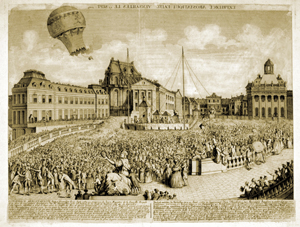
Exprience aerostatique faite Versailles le 19 Sept 1783

[sic; title appears in reverse]
Engraving, 29.3 x 37.8 cm. (sheet) (plate size indeterminate)
XP-XL-2 (1062)


The title of this print appears in reverse so that when the print is viewed thorugh a vue d'optique device, the wording would read normally. Given in French and German, the caption explains the specifics of the balloon, including its size and coloration. The crowd, which is drafted in great detail that would be further enhanced by the vue d'optique, is described as numbering 130,000.  Part of the inscription (in reverse) on the stone pediment in the foreground appears to read "monr. Vicvin." Liebmann and Wahl (#197) identify the sculpture in the foreground as a personification of Genius and suggest that the print was produced by the Augsburg printer Probst. (This print appears to be a German copy of XP-XL-2 1064, issued by Le Noir, in which the inscription on the stone pediment in the foreground may include the artist's signature; it reads: "R M" or "P M" and "ergon ex hmerwn" ["six days' work"]. Other copies of the Le Noir plate are the colored prints XP-XL-2 1060 and XP-XL-2 1061.)


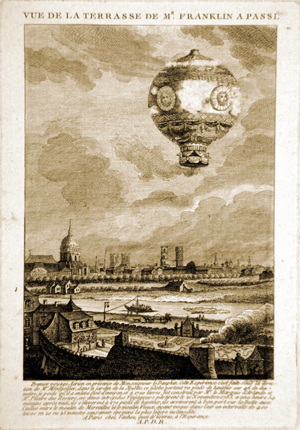
Vue de la Terrasse de Mr. Franklin à Passi

P.G. Tavenard [after Étienne Chevalier de Lorimier (1759-1813)]
Paris, [1784?].
Etching, 15 x 10.5 cm.   
XC-10-2M (2893)

This view was seen by Lorimier from Benjamin Fanklin's home, reportedly with Franklin at his side. Franklin's house in the suburb of Passy, where he had settled as a diplomat in 1776, was quite near to the Château de la Muette, where the balloon was launched on November 21, 1783, carrying the first two people to fly, the Marquis d'Arlandes and Pilâtre de Rozier. This print, a variant of which forms the frontispiece of Faujas de Saint-Fond's Prèmiere suite de la description of 1784, depicts the scene from an intriguing perspective of earthiness, to which the free flight of the balloon strikes a forceful contrast. Two observers atop a roof on the lower right watch the progress of the balloon. According to Préaud, the publisher of this print, Nicolas-François Le Vachez, moved his establishment from rue de Grenell-Saint-Honoré to quai des Gevres in October 1784; as the latter address is given on the lower right, we can assume that this print appeared after this date. On this copy the ink has been effaced from parts of the envelope.  (This is undoubtedly part of a series by Le Vachez, discussed in the description of print XC-10-2M 2878: "Vuë d'Annonay en Vivarais," although the style of the title's lettering varies from others in the series, using roman capitals as in print XL-6 4622. For a view of quite another subject, but which shares the perspective of the rooftops, compare print XL-38 3167: "Thirty-six views around Fugaku.")


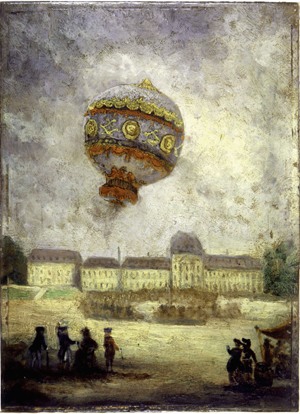
[Montgolfière of November 21, 1783]

Painting on wood, 29.5 x 21.4 cm.   
XP-XL-41 (3236)

The grounds of the Château de la Muette were crowded with thousands of people, yet the anonymous artist of this painting chose to present fewer spectators, giving a more casual impression.  The coloration of this painting suggests a relatively modern origin, although its rapidly sketched style makes a charming statement.


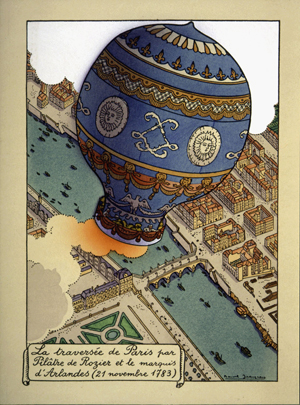
La traversée de Paris par Pilâtre de Rozier et le marquis d'Arlandes (21 Novembre 1783)

Marcel JeanJean (1893-1973)
Colored Lithograph, 24 x 17 cm.
XP-XL-14 (1500)

This dynamic view of the ascent of November 21, 1783, takes a perspective rarely exploited before the twentienth century. JeanJean, a World War I aviator and illustrator who was appointed official painter to the French minister of air in 1931, became known for his books and drawings on aeronautical themes. (This print is part of a series by JeanJean, including prints 1498-1500.)


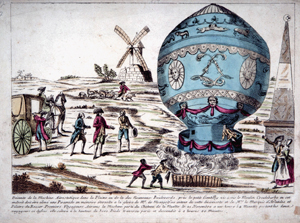
Décente de la Machine Aërostatïque dans la Plaine au de la des Nouveaux Boulevards près le petit Gentilly . . . en cet endroit doit etre élevé une Piramide en mémoir éternelle a la gloire de M r. de Montgolfier. . .

Etching, colored, 22.7 x 30.4 cm. 
XP-XL-2 (3442)


This interesting print shows the landing of a Montgolfier balloon on November 21, 1783, an event witnessed by some who followed the balloon across Paris on horseback. There is a curious and probably inaccurate representation of the fire used to heat the balloon while aloft, and there is little trace of the chaotic conditions that prevailed at this landing. The author of this print suggests in the caption that a monument (which can be seen at right) be erected at this site, although the structure never materialized. A study by Elisabeth Boselli in the magazine Icare (105, 1983/2) discusses the place of landing at length and again proposes that a monument be erected there. Historian Charles Dollfus was able to identify the place of departure by speaking to the gardeners of the Bois de Boulogne, who had preserved an oral tradition.


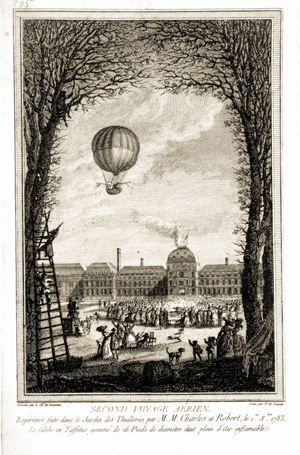
Second voyage aérien. Expérience faite dans le Jardin des Thuilleries par M.M. Charles et Robert, le 1er. xbre. 1783

Nicolas De Launay (1739-1792), after a design by Étienne Chevalier de Lorimier (1759-1813), [Paris, 1784].
Etching and engraving,  15.4 x 10.5 cm.
XC-10-2C (3386)


A cult of sorts grew around J.A.C. Charles, whose successful flight on December 1, 1783, in the first man-carrying gas balloon seemed to capture the intrigue of the Parisians more than any other aeronautical event had done. Perhaps his popularity was due to his personality and style, both said to have been powerfully disarming. In any case, many thought his method of inflating balloons to be superior to the methods of the Montgolfiers, whose balloons were comparatively limited in endurance.


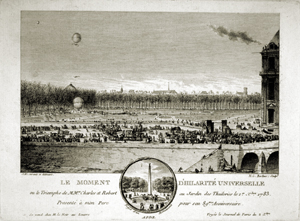
Le moment d'hilarité universelle, ou le triomphe de MMrs. Charles et Robert au Jardin des Thuileries le 1er. xbre.  1783.  Presenté à mon Pere pour son 89me. Anniversaire

J.H.E (i.e., Johann Heinrich Eberts) invenit et delinavit; H.G. Bertaux, sculpt. Paris, [1784]. Chez Le Noir.
Etching,  15 x 20.3 cm.
XP-XL-4 (1141)


A formal depiction of the balloon of December 1, 1783, this print is unusual (though not unique) for its portrayal of the balloon as it lifts off and again as it gains altitude. In addition, the artist shows the small pilot balloon released by Étienne Montgolfier in the upper left. The small vignette titled "Projet d'un monument" shows a tall pyramid surmounted by a small balloon, with two figures and a plaque at the base; the figures form part of a fountain. This design was no doubt intended for an unfinalized government competition to select a monument design in 1784 to commemorate the invention. In an unusually long notice, which includes many interesting details, the appearance of this print was announced in the Journal de Paris of March 5, 1784. Without mentioning his name, the notice refers to the artist as an amateur who produced the print in homage to his father, 89 years old. The artist donated 100 copies to benefit octogenarians, about a fifth of which he wished to have bestowed on an 89-year-old man. Some copies of the edition were printed on fine "Holland paper," in order to reduce the weight for those who wished to send the print abroad. The print was available from Le Noir ("sous le passage de la colonnade du Louvre") for 1 livre, 4 sous. The preparation of the plate is credited to Bertaux and Guttemberg le jeune, although only the former is mentioned on the print. The first four words of the title apparently refer to a phrase used by Charles in describing his flight in the Journal de Paris of December 13, 1783. (The vignette is repeated on another print in the Gimbel collection, "Etienne et Joseph Montgolfier, freres, Nés à Annonay en Vivares" [XC-10-2M 2870] where the vignette is titled: "Projet d'un monument a elever a M. Charles." The vignette was cynically remembered in 1784 when it was parodied on print XP-XL-5 1188: "Les deux Midas.")


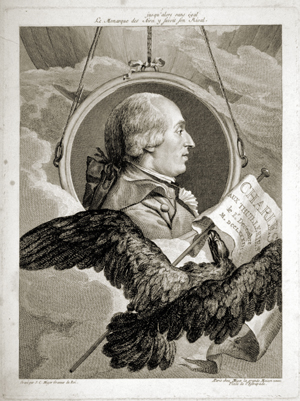
Charles, aux Thuilleries,
le 1r Decembre MDCCLXXXIII

Simon Charles Miger (1736-1820)
Paris, [1784]. Engraving,  25.2 x 19 cm.   
XP-XL-20 (1821)

The physicist and balloonist J.A.C. Charles is shown before the image of a balloon (background, at top). Three lines of poetry suggest that Charles, personifying technology, has displaced a symbol of nature, the eagle:

Until then without equal
the King of the Air
follows his rival there.

Miger was an expert and well-known engraver, who had been elected to the Académie in 1778. The Journal de Paris of March 31, 1784, as well as the Gazette de France of April 6, announced this print, priced at 2 livres, 8 sous. (Marsh [pl.14] shows a crayon drawing upon which this print was no doubt based. Print XC-10-2C 3370 is the same work facing left, engraved by P.G. Tavenard. Compare XP-XL-20 1822, "Charles aux Thuileries le 1er December 1783" [another portrait]. The same three lines of poetry are repeated at bottom.)


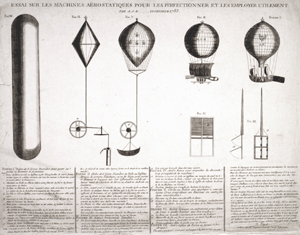
Essai sur les machines aërostatiques pour les perfectionner et les employer utilement.  Par A.J.R...........Ingénieur. 1783.

Paris, [1783?]. Etching,  37 x 46.5 cm. 
Letters on balloon at right: "M./A.P.," and second from right: "M.C.R."
XP-XL-4 (1121)


The invention of the balloon brought forth many ideas for utilizing the new technology, and this print offers designs for a pump, a lift, and a semi-dirigible balloon. It suggests (in the left-most figure) a cylindrical shape for the carrying of "100 people and baggage," which is equipped with a chimney and stove to generate smoke and gas from wet straw, gunpowder, oiled paper, wool, rags, peat"—anything which can be cheaply had." The acronym "A.J.R." in the caption may refer to Anne-Jean Robert, who with his brother assisted J.A.C. Charles with his balloons and later constructed an elongated balloon which is shown in print XP-XL-4 1159.


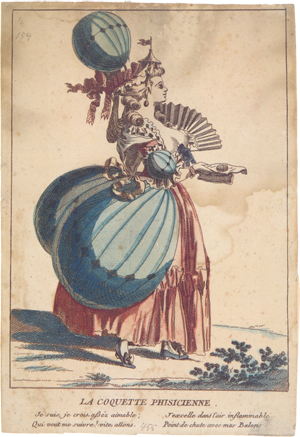
La Coquette Phisicienne

Etching, 24 x 16.7 cm.   
XL-15 (4624)


The prints that survive of the balloon costume that was popular during the brief period of the "balloon craze" satirize the subject, so it is difficult to judge from them the exact nature of the style. No doubt exaggerated, they are consistent in showing hats, with sleeves, shoes, and skirts all enlarged with balloons. This print with its caption is apparently meant to suggest a moral lightness. (The figure in XP-XL-15 4624, "La Coquette Phisicienne," is copied in reverse in print XP-XL-15  1564, "La phisicienne galante," where the hat is changed. Other prints depicting the balloon costume are XP-XL-15 3433, "L'homme aux balons ou la folie du jour"; XP-XL-15 1563, "Le petit-maitre phisicien"; and XP-XL-15 1565,"Madame la Comtesse de M . . . devant aller voir la fameuse experience.")


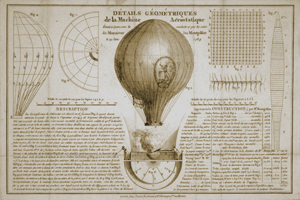
Détails géométriques de la Machine Aérostatique Élevée à Lyon

Lyon, (1784). 
Engraving,  22 x 32.5 cm.
XP-XL-2 (1082)


In early December 1783, Joseph Montgolfier began to assemble this balloon, which was financed by a subscription. Despite a paternal prohibition against flying, Montgolfier hoped to make a long flight in the aircraft. The balloon was named for Jacques de Flesselles, Intendant of Lyon, and bore insignias symbolizing History and Fame. It was assembled with the help of Jean-François Pilâtre de Rozier, who arrived at Lyon on December 27. Progress was slowed by Pilâtre's commandeering style, by rain, by fire, and finally by snow. On the nineteenth of January 1784, the balloon was ready and six people (including Joseph Montgolfier and Pilâtre) took their places in the gondola—despite the evident frailty of the now-decrepit paper and cloth envelope. As the balloon left the ground, a seventh person jumped aboard. After a flight of about fifteen minutes, the envelope began to fail, and the balloon descended quickly to earth; it was the only time a Montgolfier ascended in a balloon. (The section "Aperçu de la construction par Mr. Montgolfier" [a feature sometimes seen on prints of the period] gives enough detail to let the enthusiast construct a balloon. Many prints were published of this balloon, including some that show a continuous scene on the envelope, without the four medallions as here.)


Experience du Vaisseau Volant de Mr Blanchard le 2 Mars 1784

Paris, [1784?]. Chez Basset. 
Etching,  19.4 x 31.4 cm. (image)
XP-XL-6 (1220)


The resurrection of the term vaisseau volant in a print apparently commissioned by Jean-Pierre Blanchard suggests that the inventor was hoping to salvage his reputation by modifying the ornithopter of the same name that he had constructed in 1782. This print shows two views of Blanchard's vaisseau volant, the center one with parachute, labeled "as it should have departed," and the view at right, labeled "as he departed by himself." The parachute visible on the left was arranged below the envelope, but not carried on the actual flight because of its weight, and one can see the "wings," or oars, have been left behind as well. Apparently to explain why equipment central to the trial was abandoned, the caption relates that Blanchard was to be accompanied by aeronaut Dom Pêche, but a young man, who hoped to accompany the balloonists, threw himself into the basket, "heavily damaging the machine." After a very brief flight with Dom Pêche, Blanchard ascended for a flight of three hours leaving Dom Pêche, the parachute, and the wings that are shown on the ground. It was the fourth man-carrying flight of a balloon.


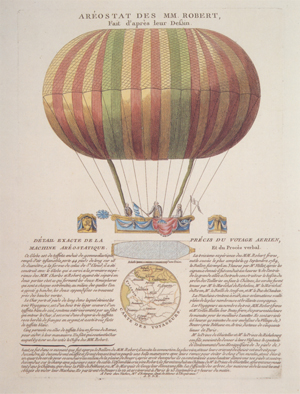
Aréostat des MM. Robert, Fait d'après leur dessin

Paris, [1784?]. Chez [Le] Vachez. 
Etching and engraving,  27.3 x 19.5 cm.
XP-XL-4 (1159)


The elongated shape was immediately seen as a practical way of making the balloon aerodynamic, and as early as September 1784, the brothers Robert (who had served as technicians for J.A.C. Charles) had completed this aircraft and readied it for trial. The inset "Cartes des voyageurs" would no doubt have amused those who saw the balloon from afar and were curious as to the position and course of the aircraft.  (On a related print by the same publisher [Le Vachez] see XC-10-2M 2878. The medallion: "Cartes des voyageurs" is similar to other maps produced of flights, for example Gimbel XP-XL-6 1212: "Carte des marches aërographiques"; XP-XL-4 4604: "Rentrée du char triomphant"; and XC-10-2M 2870 "Etienne et Joseph Montgolfier, frères nés à Annonay" [with its "Cartes des premiers voyages aërostatiques"].)


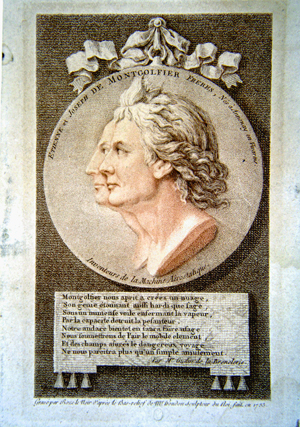
Étienne et Joseph de Montgolfier frères, Nés à Annonay en Vivarais.

Roze (or Rose) Le Noir, after a bas-relief by Jean-Antoine Houdon (1741-1828) [Paris,1783].
Color engraving, and stipple engraving, à la poupée, in sepia and brown,15 x 9.5 cm.
XL-41 (3237)

Sculptor Jean-Antoine Houdon produced a large number of busts of contemporary notables in various media between about 1771 and 1789. Houdon's 1783 relief of the Montgolfiers appears in several prints of the collection and on the medal of 1783 (XM-11 3506). This print was announced in the Journal de Paris of December 18, 1783, possibly "to be joined with Faujas de Saint-Fond's work," the Description des expériences aérostatiques, although in fact the book appeared without it. Rose Le Noir was either the daughter or the sister of the publisher Le Noir, who produced a number of early aeronautical prints. The eight lines of verse by Gudin de la Brenelerie at the base of this print promise that soon "the dangerous journey will no longer seem a mere entertainment." (A print with a similar title [lacking the "de" before "Montgolfier"] was designed and engraved by Robert De Launay [1754-1814], brother of Nicolas De Launay, and announced in the Journal de Paris of October 17, 1783. An advertisement for the De Launay print appeared in Faujas de Saint-Fond's Description [page xl], offering the print at the book's publisher [Cuchet] as well as the artist's, for 1 livre, 4 sous. The Gimbel collection includes five prints based on Houdon's motif.)


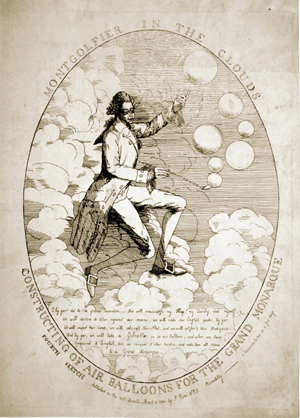
Montgolfier in the Clouds. Constructing of Air Balloons for the Grand Monarque.  Fourth Sketch

[London], published March 2, 1784.
Etching, 35 x 24.7 cm.
XP-XL-15 (1575)

In the monologue given as a caption, "Montgolfier" describes the ways in which the French will use the new invention to dominate the world. Clearly, the enthusiasm for Montgolfier and his useless balloons is seen as a trivial manifestation of French egotism. The bubbles are no doubt meant to suggest the insubstantial nature of the invention, relying upon a sense of the word "bubble" to connote a hoax. The caption makes mention of the British fortress of Gibraltar, whose siege by the Spanish and later the French from 1779 until February of 1783 is often cited as a motive for Joseph Montgolfier's invention of the balloon. (Apparently part of a series, as the title mentions "fourth sketch" and promises "a companion to follow in a few days.")


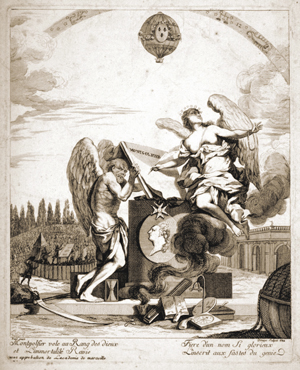
Montgolfier vole au Rang des dieux

Louis-Alexandre de Buigne, after a painting by Jean Biard [Marseilles], 1784.
Etching,  24 x 19.5 cm.
XP-XL-2 (1089)

In this etching, the name of Montgolfier is being entered by Immortality into the fastes du génie (or annals of genius) held by Time. The portrait bust on the pedestal is thought to be Louis XVI.  The balloon pictured with three fleur-de-lis is a bit enigmatic as it does not appear in any other print of the 1780s; it is probably intended to represent the balloon in general. The zodiacal spectrum at top with its Arabic numeral "12" between Libra and Scorpio must represent some event (on October 12?), but its significance is unknown. Unlike previous schematic uses of ethereal vapors to suspend figures, here the figure of Immortality rests on vapors that emanate from a man-made sack found among a heap of scientific instruments in the foreground. (A copy in the Bibliothèque National in Paris has this addition to the last line: "Se vend 24 s. à Marseille ché Briard rue Vacon hotel de Saxe.")


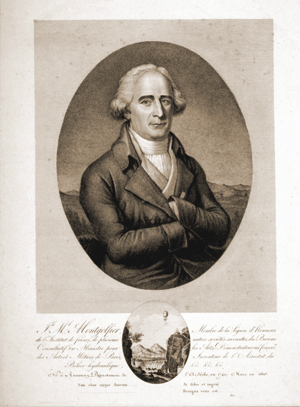
Jh. Ml. Montgolfier, Membre de la Légion d'Honneur

ca. 1810.
Stipple Engraving, 38 x 28.5 cm.
XL-20 (1836)


Joseph Montgolfier, who invented the balloon in 1782, was absent-minded in the extreme. It is said that, while traveling, he once forgot his horse, and once, his wife. Best known for his work with the balloon, he was perpetually musing and experimenting. This memorial print, issued after Montgolfier's death in 1810, celebrates both the balloon (or aërostat) and his bélier hydraulique, which worked to capture the force of moving water and convert it to use in pumping.  Although the vignette ineptly shows a gas balloon rather than a hot-air balloon, it does draw the viewer's attention to a bélier hydraulique lifting water high above a river. The scene evokes the dramatic countryside near Annonay, where Montgolfier was born in 1740. A few lines from The Odes of Horace (II, 18) serve as an epithet:

Non ebur neque Aureum . . . at fides et ingeni Benigna vena est. (Neither ivory nor gold . . . but loyalty and a kindly vein of genius.)


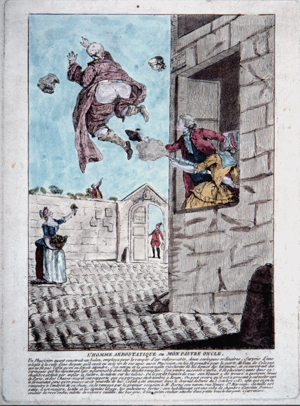
L'homme aerostatique ou mon pauvre oncle

[Paris, 1784].
Etching, colored, 26 x 20.1 cm.   
XL-15 (4628)

A letter in the Journal de Paris of October 3, 1783, describes the flight of the letter-writer's uncle, who, suffering from colic, accidentally received into his anus an injection of the "inflammable air" used in balloons, which caused him to fly from his bed and out the window. His nephew implored the Journal to publish his letter so the uncle might be found. Apparently this letter became something of a sensation as several prints appeared featuring the subject. On the door in the background one can read the words "Assemblé  Dexperience"; on the corner of the building, above the window, one reads "R. Neuve, St. Morceaux." (Related prints are XP-XL-15 1581, "The Day's Folly; XP-XL-15 1582, "L'homme aérostatique"; XP-XL-15 3434, "Avis très important"; and XP-XL-15 3448, "Graces à Dieu, voila mon Oncle retrouvé." A print with this title was announced in the Journal de Paris of April 17, 1784.)


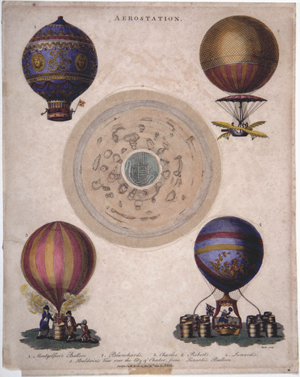
Aerostation

J.Pass
London, published by J[ohn] Wilkes [of Millard House, Sussex,] June 28, 1803.
Engraving, colored, 19.8 x 24.7 cm.
XP-XL-9 (1362)

This print shows two popular balloon flights: the ascent of Pilâtre de Rozier and the Marquis d'Arlandes on November 21, 1783, and Jean-Pierre Blanchard's ascent of March 2, 1784. At bottom are shown preparations for the launch by J.A.C. Charles and the brothers Robert on August 27, 1783, and Vincent Lunardi's balloon, which first flew on September 15, 1784. In the center appears the view of the city of Chester as recorded by Thomas Baldwin and first published in 1786. The publisher, John Wilkes, issued a number of specialized offprints based on the articles in his Encyclopaedia Londinensis, and this print may have been prepared to accompany one on aerostation, of which no record can now be found. (A similar plate engraved by [Inigo] Barlow is dated 1796 and appears in the 1797 and 1810 editions of Wilkes' Encyclopaedia Londinensis. The Gimbel collection includes an earlier print in the same genre, print XP-XL-22 1867, "Representation of various balloons, with the methods of constructing and filling them.")


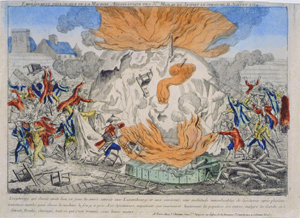
Embrâsement déplorable de la Machine Aërostatique des Srs. Miolan et Janinet le dimanche 11 Juillet 1784

Paris, [1784?].
Engraving, 25.5 x 38.2 cm. (image)
XP-XL-5 (1185)


The engraver Jean-François Janinet and the Abbé Miolan constructed a hot-air balloon in Paris with funds raised through subscription. Subscribers were entitled to watch the inflation and flight from within the confines of the Luxembourg Gardens; the event was regulated by the police who had dealt with trouble at other such events. Twenty thousand spectators packed the gardens on Sunday, July 11, 1784, suffering through long delays on a still, sweltering day. Janinet and Miolan (like all balloonists in all times) strongly felt their obligations to the crowd, and inflated their balloon despite the heat, the resulting lack of lift, and probable failure; when the balloon's crown caught fire, the ascent was postponed. The spectators in the garden left peacefully, but the crowd outside the garden entered and destroyed the balloon.

On the lower left one can see Janinet and Miolan (depicted as an ass and a cat), together with the Marquis d'Arlandes, hurrying themselves from the scene. The ladders may have been provided to those who wished to climb into the nearby trees and walls to watch the ascent; certainly the chairs so prominent in this depiction were available only to the aristocrats who could afford to enter the enclosure. To the eighteenth-century eye this print symbolized a revolt upon the social hierarchy.  (Colonel Gimbel collected a number of prints satirizing this event or the characters of the proprietors including: 1181, "Un chat est un chat"; 1182, "Les phisiciens travaillants à l'observatoire dédié aux souscripteurs"; 1183 "Jugement définitif en faveur des Srs. Miolan et Janinet" (not in color); 1184, "La physique confond l'ignorance."  All are in XP-XL-5. Grand-Carteret [p. xiii] shows an unusual print of this aircraft rising from the ground titled "Machine aërostatique de MMrs. l'Abbé Miolan et Janinet.")


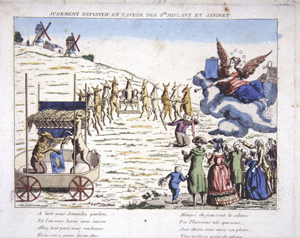
Jugement définitif en faveur des Srs. Miolan et Janinet

[1784?].
Etching, 20 x 24.5 cm.
XP-XL-5 (1186)


A murderous ocean of ridicule descended on the Abbé Miolan and Jean-François Janinet, manifested in numerous prints whose symbols, as in this etching, parodied their names. Miolan, whose name sonically resembled the French word miaulement (meowing), kneels before the same symbol of immortality that Jean Biard employed in the austere print XP-XL-2 1089, "Montgolfier vole au rang des dieux." Janinet, whose name suggested  i, or ass, is shown at left, eating hay in a cart; the cart resembles the gondola of the balloon. Sued by one subscriber for the cost of the subscription, Miolan prevailed in court, having solicited the supporting opinions of Pilâtre de Rozier and Faujas de Saint-Fond.  Intent on vindicating his name as a physicist, he later received an exonerating opinion from Étienne Montgolfier. The author of this print asserts in the text:

You wrongly asked for pardon, and are justly derided.
Come! all of Paris condemns you, you will never be but an ass.
Eat hay [i.e., be a fool]; it's the wages of physicists like you.
You knew how to please the young asses, and will excite no jealousy.

One historian has pointed out that it was not the paying subscribers who rioted but the spectators outside the walls; although the rioters had not lost money per se, they were enraged at waiting for what they came to consider a fraud. Miolan and Janinet were never able to overcome this perception with the populace of Paris, which no doubt counted among the asses described above the applauding aristocrats on the right of the print. The image held by the ass in the cart is based on the engraved admission ticket issued for this event, one of which is preserved in the Gimbel collection. It depicts the balloon before a rainbow and two small balloons (or spheres) on tethers above and below the main balloon. (A less-detailed version of this print, in reverse, is the uncolored XP-XL-5 1183, which is an etching with aquatint in sepia. There has survived, to my knowledge, only one nonsatirical depiction of this balloon, which was to test vents in the envelope as a means of horizontal propulsion, at the suggestion of Joseph Montgolfier.)


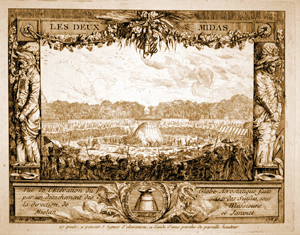
Les Deux Midas.  Vue de l'Elévation du Globe Aërostatique faite par un détachement des Gardes Suisses, sous la direction des Messieurs Miolan et Janinet le 11 Juillet 1784

[1784?].
Etching, 22 x 25.6 cm.
XP-XL-5 (1188)


Full of insults, this print represents the unprecedented assault on Miolan and Janinet in the popular culture of Paris. The two balloonists are shown at right and left, both with the ears of an ass, and Miolan with the head of a cat. Their buttocks are bared in the manner of other satirical prints that play upon the contemporary association of human gas and the "air inflammable" used in balloons.  At the feet of the balloonists stand upturned hats full of coins, beneath which the two captions refer to the "elevation" attained by the balloon, the bottom-most claiming it to be "27 feet, 11 inches, 5 lines, with the help of a pole of like height." Around each balloonist's neck is a noose-like vine of oak leaves.  The satirical vignette at bottom, titled "Projet d'un monument," is clearly based upon the vignette of the same title in print XP-XL-4 1141, "Le moment d'hilarité universelle" and represents either an upturned hat ready to receive the charity of the people or a barber's bowl, perhaps playing on the verb raser (to shave, to demolish). In colloquial use, the verb also means "to bore." The proposed monument with its fetters is surrounded with the inscription:

Chacun son métier, et les vaches seront bien gardées (Everyone to his craft, and the cows will be well tended).

It appears that the central portion of this print may have been prepared as a formal depiction of the inflation, and the satirical borders added following the loss of the balloon on July 11. The title ("The Two Midas") evokes the mythological king who was given the gift of "the golden touch," and no doubt refers to the venality of the two balloonists. The central ornament at top prominently features a whistle (evoking the practice of hooting) and a pipe of Pan, sometimes used for disciplining dogs and cats. Viewers conversant with mythology might have recalled that after Midas had judged a musical contest between Apollo and Pan and decided against the former, Apollo changed Midas' ears into those of an ass.


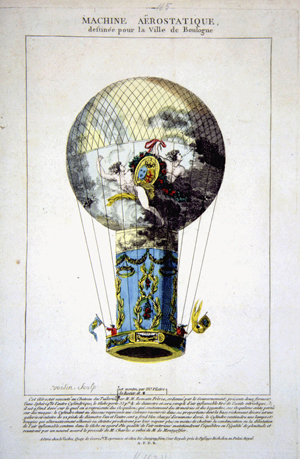
Machine aërostatique, destinée pour la Ville de Boulogne

Voisin, sculp.
1785.  Etching, 29.8 x 18.2 cm.   
XP-XL-5 (4623)


This balloon was launched from France on June 15, 1785, in an attempt to cross the Channel. It was the first balloon that combined hot air (in the long column) with hydrogen (in the sphere). Although technical information is vague, it appears that in order to provide lift, the heat from the burner was intended to rarefy the air in the column rather than the gas in the sphere. Like other prints, this one shows the two parts of the balloon as contiguous, although other descriptions and other prints indicate that a space of several yards separated the two parts. Flown by its builder, Jules Romain, and the famous Pilâtre de Rozier, this kind of balloon came to be called a "rozière." Using helium for a lifting gas and propane to heat it, the rozière became popular for long flights. (The same print in Bruel [106] has Calais rather than Boulogne in the title, no doubt indicating a change of plans in the launch site.  Print XP-XL-5 1199 is an imaginary view of the balloon setting out from Calais.)


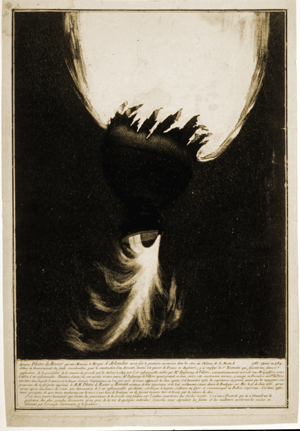
Monsieur Pilatre de Rosier qui avec le Marquis d'Arlandes avoit fait la premiere ascension dans les airs ou Château de la Muette le [21 novembre] 1783

Aquatint, 40 x 27.5 cm. 
XP-XL-25 (2015)


The title is not directly relevant to the event illustrated; taken from the first line of the caption, it describes Pilâtre de Rozier as the aeronaut who accompanied the Marquis d'Arlandes on the flight from the Château de la Muette in 1783. Depicted in this print is the world's first aeronautical disaster, which occurred when Romain and Pilâtre's balloon, shown in print 4623, caught fire and crashed to earth while still over France. The fire is usually attributed to sparks from the burner, which ignited escaping hydrogen; but another theory postulates that the valve line, which ran outside of the envelope to the top of the balloon, produced a spark while being worked against the gold-leaf decorations on the envelope. Pilâtre was dead when onlookers reached the balloon, and Romain died shortly after. It is said that Pilâtre's fiancée, Susan Dyer, was so shocked by the sight of the crash that she died soon afterward. (The publisher of this print must have lacked reliable information about the date of the flight by Pilâtre de Rozier and the Marquis d'Arlandes [which was November 21, 1783]—a blank area in the caption has been left for it.)


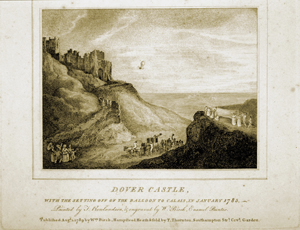
Dover Castle, with the setting off of the balloon to Calais, in January 1785

William Russell Birch (1755–1834), after a painting by Thomas Rowlandson (1756–1827)
London, 1789.  Etching, 15 x 17.5 cm.
XP-XL-6 (1230)


Shown against the backdrop of Dover Castle is the balloon of Jean-Pierre Blanchard and his passenger, John Jeffries, an American physician who had moved with his family to London. Trained in both medicine and physics, Jeffries financed the flight to conduct his own scientific research. Their two-hour flight carried them across the Channel to France on January 7, 1785. During the voyage the two balloonists had to jettison nearly everything, including some of their clothing, in order to avoid landing in the Channel. Then, as they flew over France near Calais, they jettisoned their urine to slow their descent.  Despite the calmness permeating this print, the relationship between the two men was poor; Tom Crouch characterized the preparations for the flight as a time of "constant bickering." (Print XP-XL-6 1229, an etching with simple lines, is based upon the same painting. The event was a popular subject for painters. Liebmann and Wahl [#48] show a similar painting, "The balloon leaving Dover 1785 from the oil painting by E. W. Cocks, in the possession of Sir Mortimer Singer." Leichter als Luft [p. 83] shows the Cocks painting [p. 179] as well as an oil attributed to the early nineteenth century, which is in the Science Museum, London.)


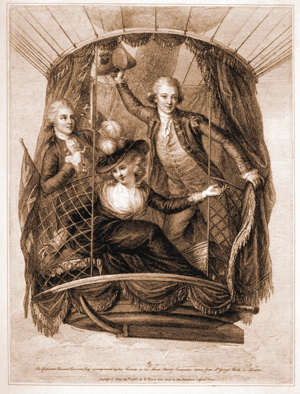
The celebrated Vincent Lunardi Esqr. accompanied by two friends in his third aerial excursion

Francesco Bartolozzi (1728–1815), after a painting by J.F. Rigaud (1742–1810).  London, 1785. "Published June 25, 1785 by E. Wyatt next door to the Pantheon, London."
Etching, 33.5 x 25 cm.
XP-XL-7 (1263)

This elaborate print, which emphasizes the dash of the aeronauts more than the flight, was published on June 25, 1785, to commemorate a planned flight on June 29. We see that the balloon was to be readied for three people. A memoir written by "Mrs. Sage," the woman depicted in the print, records that five people crowded into the basket when the balloon was inflated; their weight proved too much for the available lift. Three, including Lunardi, left the gondola, and Mrs. Sage and the 25-year-old George Biggin ascended, making Sage "the first English female aerial traveller." Sage mused that Mr. Biggin thought it "no degradation to communicate his observations to a woman, of whose understanding, I am proud to think, he had not a contemptible opinion." While aloft, Biggin made various scientific observations, holding an electrometer with two pith balls at arm's length and "exposing it to a cloud we were then passing . . . he told me his conclusion, which was that the electricity of that cloud was negative.”

(With the glass, one can see the ghost of an eradicated line of text that lies behind the last line of the caption in this print; the eradicated caption appears to include the word Oxford." This print can be found in three states: one with the title: "V. Lunardi Esqr. Mrs. Sage G. Biggin Esqr.," published May 13, 1785, by "Mr. Bovi . . . Oxford Market"; one with the title as above ["The celebrated Vincent Lunardi . . ."]; and one with the title: "The three favorite aerial Travellers."

In the last state, the artist has added a hat and improved the collar and tie of the figure on the left, which is no doubt George Biggin. This change might have resulted from the wealthy Biggin's objection that without these accessories he would appear as the social inferior of Lunardi, although in fact Biggin had provided substantial monetary support to the balloonist. Gibbs-Smith describes Lunardi's dress as "the uniform of the Honourable Artillery Company." The cannon-like device below the basket may be intended to represent and publicize Lunardi's poorly documented experiments with cannons. What seems to be the original drawing for this print is shown in Alvin Josephy, Adventure of Man's Flight, p. 52. This plate reportedly existed and was being used in the twentieth century.  The engraver, Francesco Bartolozzi [whose life dates have also been given as 1748—1815], engraved Lunardi's portrait in 1784 [Gimbel XC-10-2A 3261].)


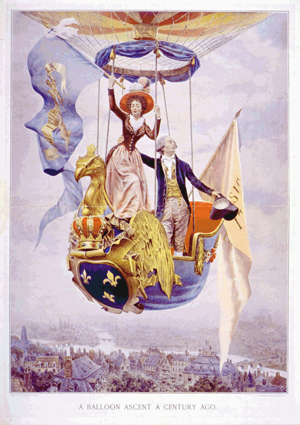
A balloon ascent a century ago

Maurice Leloir (1853-1940)
1889.  "Chromotypogravure,"  52.5 x 38 cm.
XP-XL-6 (1255)

Large, fanciful, and striking, this "chromotypogravure" shows two aeronauts aloft in an ornate car adorned with French symbols. The artist, a specialist in historical costume and known for book illustration and theatre-set design, seems to have borrowed from the print that shows Lunardi, Sage, and Biggin (XP-XL-7 1263). It is possible that Jean-Pierre Blanchard is the male figure, although it is difficult to determine who the woman is meant to be (Marie Madeleine Sophie Blanchard did not make her first ascent until 1804). The large flags bear Virgil's phrase, which is used repeatedly in connection with ballooning: Sic itur ad astra (thus immortality [or the heavens] is/are gained); the same motto was given to Pierre Montgolfier's family when ennobled in 1783 by Louis XVI. This is romantic art fit for a cereal box, shown for its artistic rather than historic properties. The print is signed and dated in the scene at lower right. (In Neidhardt-Jensen [p. 103] this same print appears titled: “Une ascension, il y a cent ans.”)


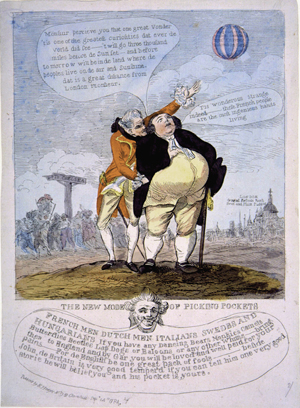
The New Mode of Picking Pockets

London, published by E. Hodges, September 14, 1784.
Etching, 32.5 x 22.5 cm.    
XL-5 (3431)

This British print was published while the moneyed were still within the throes of balloonmania, but it evokes a growing suspicion regarding the balloon and its increasingly venal promoters. In a style like that of "Aerostation out at elbows" (see print XP-XL-7 1264), it depicts a well-manicured balloonist as a pickpocket and knave. The print is rather crudely crafted, and within the caption for London on the right, the wording has been reworked to correct an error with little attempt to erase the old lettering. This print no doubt was inspired by the balloonist Chevalier de Moret, who had built a balloon and prepared to launch it from a garden in Chelsea, London, on August 11, 1784. Although he claimed to be an associate of the Montgolfiers, "Count" Moret apparently knew little of ballooning, and his balloon failed to ascend despite three hours of preparations. The balloon finally collapsed into the fire, at which point part of the crowd of 50,000 rioted, entered the enclosure, robbed the subscribers, and destroyed benches, windows, and equipment. Hodges published this print the day before the first successful ascent in England by Vincent Lunardi. (George [vol. vi., p. 166] lists this print without showing publisher and with the attributed date of August 1784, suggesting that another state of this print [or a copy] appeared without this information.)


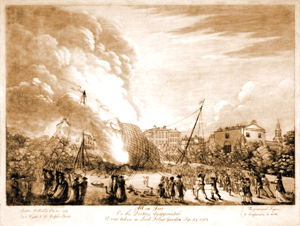
All on Fire, or the Doctors disappointed; a view taken in Lord Foley's garden Sep. 29, 1784

London, published by E. Wyatt, October 20, 1784.
Mixed method intaglio, etching with mezzotint, 27.5 x 36.5 cm.
XP-XL-5 (1195)


The printmakers of London had another aeronautical attempt to caricature after the hot-air balloon of Allen Keegan caught fire before launch. Associated with the anatomist Dr. John Sheldon (who later ascended with Blanchard on October 12) and possibly Jean-Pierre Blanchard, Keegan inflated the large balloon at least once in mid-August before a free-flight was announced in late September. A tradesman dealing in umbrellas and waterproof items, Keegan made his envelope of coarse varnished linen. Two numbers in lower right (1: principal figure; and 2: companion) refer to figures in the foreground, whom Marsh identifies as Blanchard (left) and Sheldon (right). Four fire engines were on hand as a precaution when the balloon was engulfed. (George [6703] reports publication on October 20, 1784, by E. Wyatt, No. 360 Oxford St., London. She tentatively attributes this print to the famous Paul Sandby [1725-1809], who designed numerous prints using balloons and flight as a motif.)


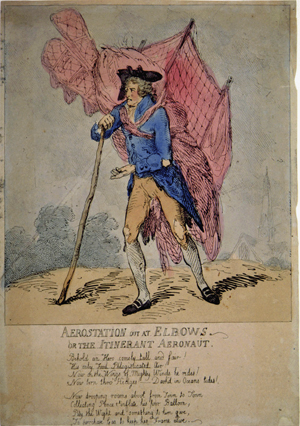
Aerostation out at Elbows, or the Itinerant Aeronaut

[Thomas Rowlandson, 1756-1827]  [London, 1785]. 
Etching, colored, 23.5 x 21.2 cm. (image)
XP-XL-7 (1264)

This caricature of Vincent Lunardi shows him in rags with an outstretched hand.  After conducting the first successful ascent in London in 1784, Lunardi made many ascents in Great Britain. This print appears somewhat providential because during December 1785, Lunardi—then on the road with his balloon—lost it at sea after an ascent from Edinburgh. He was rescued by fishermen, and his balloon was later recovered; but Britain had apparently tired of the balloon craze. After a botched ascent in Newcastle that ended with the death of an assistant, Lunardi turned his attention to a maritime life-saving apparatus. He resumed ballooning in 1788 when he returned to Italy. Eight lines of verse on the print suggest his fall from popularity, so that he, "now drooping, roams about from town to town."  Various authorities attribute this work to Thomas Rowlandson, the famous satirist. (Print XP-XL-7 1264a is an uncolored copy, and both it and XP-XL-7 1264 are trimmed; neither shows publisher or date. George [6858] reports publication on September 5, 1785, by T. Cornell, Bruton Street, London, with a second issue [6858A] on March 24, 1786, by E. Jackson, No. 14 Marylebone Street, Golden Square, London.)


Ire Expérience de la Machine Aérostatique avec les moyens de la diriger à volonté par le Docteur Jonathan

[c. 1785?  Paris?] "Dessiné d'après Nature & Gravé par Waulstaine et se Vend chez lui au No. 122 en la Cité à Londres." Copy 2 is uncolored. 
Etching, 13.7 x 18 cm. 
XP-XL-25 (2010)


This fantastic depiction of a dirigible balloon may have inspired the well-known Minerve of Étienne Robertson, although some students of the period (Bruel [De Vinck] #985; Liebmann and Wahl #257) have mistaken it for a representation of an actual flight. The print is probably a sarcastic response to grandiose schemes like the airship shown in print XP-XL-4 1121. The artist "Waulstaine" does not appear in any of the standard references, and it is curious that his prints would be captioned in French while supposedly published in London. Perhaps the name is a thinly veiled recasting of "wall stain" and represents a publisher working discreetly in Paris. (Another print [XP-XL-25 2011] shows this airship leaving the ground; showing "Waulstain" as publisher, the print purports to represent the second trial of the aircraft on January 10, 1784. The aircraft is similar to that depicted in XP-XL-16 1627, XP-XL-16 1628, XP-XL-25 2014, and others.)


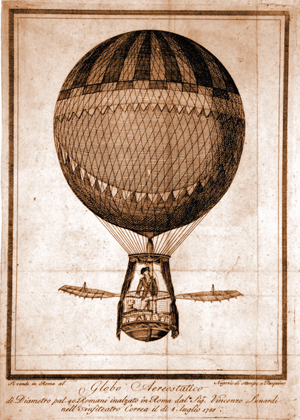
Globo Aereostatico di Diametro pal.40. Romani inalzatro in Roma dal Sig.r Vincenzo Lunardi

Rome, [1788].
Etching, 18.8 x 26.4 cm.
XP-XL-7 (1274)

In 1784 Vincent Lunardi attempted to use airborne oars, whose operation can be pretty easily surmised from this depiction of 1788. The oars were intended to move the aircraft both vertically and horizontally, but in fact could do nothing to move the great mass of the balloon. Lunardi first tried his oars very briefly during his London flight of September 15, 1784, when he claimed some effect from their use; like other devices of the period, Lunardi's oars were designed to let air flow through them on the backstroke and to provide useful resistance during the stroke. As with other prints celebrating the ascents of Lunardi and probably initiated by him, this print of his ascent in Rome on July 8, 1788, was no doubt prepared prior to the event. The circumstances of this launch were difficult, and records of it are confusing. Apparently Lunardi had some trouble with the quality or quanitity of lifting gas, and near midnight he substituted the lighter Carlo Lucangeli for himself. Lucangeli endured a short flight, unable because of fright to release his grip on the support ropes and compelled to take the valve line in his teeth in order to descend. The substitution of Lucangeli was a disappointment to the people of Rome, and Lunardi, accused of cowardice, was ordered by the governor of Rome to refund his proceeds to the subscribers. It was Lucangeli, rather than Lunardi, who ascended that day. (Another print issued of this ascent, "Globo Aereostatico di diametro pal.40 Romi inalzato in Roma," copies this one for its deptiction of the balloon, which is shown in reverse, with Lunardi looking left and his dog on the right, but it was later reworked to show Lucangeli in a cage-like basket.)


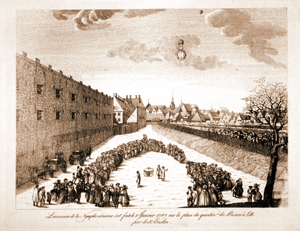
L'ascension de la Nymphe aérienne s'est faite le 1er. Janvier 1787 sur la place du quartier des Buisses à Lille par le Sr. Enslen

[1787?].
Etching, 18.5 x 23.5cm.
XP-XL-8 (1282)


"Special shape balloons" are so common today that congregations of them are popular spectacles. They date to 1783, however, and were readily available from makers in Europe's larger cities. Karl Enslen and his unnamed brother reportedly made a specialty of balloons shaped like people, and various prints exist of these dating from 1784 to 1795. The pronounced headpiece of the Nymphe may be an exaggerated representation of a balloon hat or it may be a ridiculous characterization of the period's coiffures. Another balloon, rather difficult to discern, can be seen above and to the right of the Nymphe. (Leichter als Luft [p. 64] shows a print depicting the flight of the Nymphe on July 12, 1784, in Strasbourg, with its filling apparatus below; here the headpiece can be seen to be in the form of a Montgolfier balloon. In addition, Gimbel XP-XL-22 1867: "Representation of various balloons, with the methods of constructing and filling them," depicts an aerostatic horse and rider, "which was exhibited at the Pantheon by the brothers Enslen.")


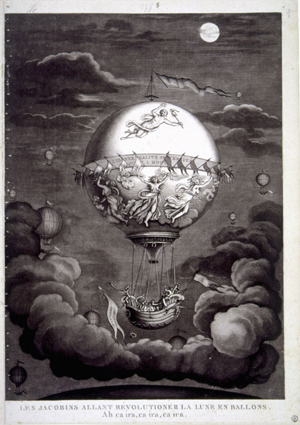
Les Jacobins allant révolutioner la lune en ballons

Mixed method intaglio, engraving with aquatint,
34.8 x 25 cm.  (image) 
XP-XL-15 (1586)

A banner hanging from the balloon at center reads: A la lune, chers amis (to the moon, good friends). Other balloons can be seen in the sky. The artist seems to be suggesting that the French Revolution had been reckless in overstepping France's borders and is attempting an improbable task. The caption ends with the words from a popular revolutionary song: Ah! Ça ira, ça ira, ça ira (Ah! It will work out, it will work out, it will work out), which was the main anthem of the revolution until the introduction of La Marseillaise in 1792. The undocumented monogram "J.S" appears in a circle below the image on the lower right.


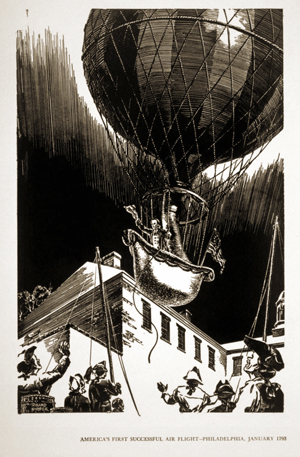
America's First Successful Air Flight—Philadelphia, January 1793

Roland F. Harper (?–ca.11000)
[1954].  Lithograph, from a scratchboard drawing, 27.8 x 18.4 cm.
XP-XL-28 (2281)

This modern drawing depicts the launch of Jean-Pierre Blanchard in Philadelphia in January 1793, considered the first ascent in America. No doubt Blanchard, who was fleeing the chaotic conditions of the French Revolution in Europe, planned to continue his practice of touring an uninitiated country and providing the spectacle of a balloon ascent in some of the larger cities. (His last ascent had been in the Tyrolean mountains of Austria in July 1792, where he had been imprisoned for disseminating revolutionary ideas.) The Philadelphia flight, which was his forty-fifth, was a financial failure.  He attempted to raise interest in further ascents by exhibiting his large balloon and by sending animals aloft with small balloons. He made stops in Charleston, Boston, and finally New York, where a tornado destroyed the balloon and killed Blanchard's 16-year-old son on September 14, 1796. When he left New York in May 1797 the New York Diary reported sarcastically, "Blanchard has at last taken his flight," a witticism reminiscent of the response to Blanchard's bateau volant, when popular French songs exploited the double meaning of voler (to fly, to steal). His next ascent was in Rouen, France, in 1798. This print was issued as a Christmas greeting from the Ajax Electric Company in Philadelphia in 1954; from 1935 to 1970, the company, which manufactures furnaces for industrial heat treating, issued a series of Christmas prints emphasizing Philadelphia history. Harper, a commercial artist known for his scratchboard work, was commissioned for at least seven of the prints between 1948 and 1957. 

(This print can be compared to the work of Philadelphian Charles R. Gardner [1901– ? ], who produced a woodcut or wood engraving in 1931 of this ascent; the print appeared in the 1943 edition of  The First Air Voyage in America, published by the Penn Mutual Life Insurance Co. of Philadelphia, whose office occupies the site of the 1793 ascent.)


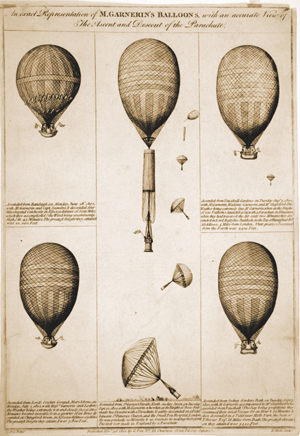
An exact Representation of M. Garnerin's Balloons, with an accurate View of The Ascent and Descent of the Parachute

H. Merke, after a drawing by G. Fox. 
London, 1802.  Softground etching, 35.7 x 24.8 cm.

Published November 30, 1802.  Upper left: flight June 28, 1802, from Ranelagh to Essex, 60 miles in 45 minutes.  Center: descent by parachute over London; first parachute descent in England, 10 minutes 20 seconds from 8,000 feet, September 21, 1802.  Upper right: descent of cat by parachute.  Lower left: July 5, 1802.  Lower right: September 7, 1802. 
XP-XL-24 (1992)


These depictions chronicle some of the work of balloonist André Jaques Garnerin, who came to England in 1802 and ascended from various parks and pleasure gardens. In 1802, the year this print was issued, the parachute was still a novel invention that had not been perfected and remained to be proved. Its origins are not positively known, although we can see the concept expressed much earlier than the technique was tried (for example, in the long-obscured work of Leonardo da Vinci and in L'uom volante of 1781 [see print XP-XL-27 2223]). A parachute appears on some of the views of Blanchard's vaisseau volant, as well as on his balloon of February 27, 1784, and Blanchard began parachuting animals from balloons on June 3, 1784. Generally the invention of the parachute is credited to Joseph Montgolfier or Blanchard (both in 1777) or to Sébastien Lenormand in 1783. The center panel of this print shows Garnerin himself descending from his balloon, "the first ever made in England by parachute." The life dates of engraver Merke are unknown, but he is known to have been born near Zurich at the end of the eighteenth century; he worked in London from 1800 to 1820. (Another work [Gimbel XP-XL-11 3446] is a watercolor depiction titled "Ascent of three Persons with a Balloon from Vauxhall Gardens 1802." It shows a small parachute descending from the balloon.)