The Colonel Richard Gimbel Aeronautical History Collection

Other Holdings


Narration By Will Ketterson

Introduction By Dominick A. Pisano

The Colonel Richard Gimbel Aeronautical History Collection is especially rich in what is termed “other holdings”—so-called ephemera that reflect Colonel Gimbel's wide-ranging interest in things aeronautical. In addition, these items reveal the breadth of the popular arts—advertising, journalism, popular music, and popular reading material—with which aeronautics came into contact in the eighteenth, nineteenth, and early twentieth centuries. This part of the collection demonstrates that aeronautics has always been shared with the public. Moreover, it shows that public response to flying dictated that various forms of the popular arts reflect aeronautical events.

Among the Gimbel collection's aeronautical ephemera that I have included here are advertisements, dime novels, excerpts from newspapers and periodicals, handbills, circulars, leaflets, postcards, programs, sheet music, tickets, a cartoon, a stock certificate, stereograph slides, and an aeronautical supplies catalogue. The Appendix lists additional representative selections of ephemera from the collection. It was difficult to decide which items to describe because the uniform excellence and representativeness of the materials bear witness to Colonel Gimbel’s skill as a collector. Finally, I have included a descriptive note for the advertisement, dime novel, and sheet music sections. These notes provide contextual information for each of those sections and explain the place of aeronautics within them.


Advertisements

Advertisements became modern, as Roland Marchand points out, when “a few advertisers had begun to appreciate the advantages of selling the benefit instead of the product—illumination instead of lighting, prestige instead of automobiles,” and so on. Some of the early examples of advertising media in the Gimbel collection that use aeronautical themes presage this advertising strategy by using balloons, airships, and aircraft to sell commercial products that have no connection with aviation. Perhaps advertisers thought that by identifying a product with flying, consumers would be transported out of the everyday world into one that represented freedom and escape—sensations associated with flying. The pleasant associations would induce them to buy products. This trend continued into the 1920s and 1930s, as aviation became more popular and advertisers attempted to exploit the glamour and speed of the airplane and the celebrity status of famous aviators to sell everything from cigarettes to motor oil.


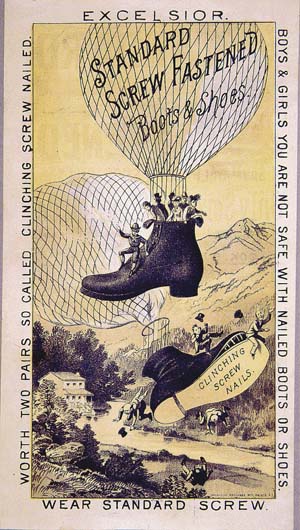
Excelsior Standard Screw Fastened Boots & Shoes

Date unknown
Advertisement, 9.5 x 17.5 cm.

This advertisement is an early example of how aeronautical themes were used to sell manufactured products in the United States. Shoes and balloons may seem dissimilar, but the advertisement successfully integrates the two. It depicts a Standard Screw Fastened Shoe going aloft in a balloon, while another with "clinching screw nails" plummets to earth. The reverse advertises "James Shannahan, dealer in Boots, Shoes, Slippers, and Rubbers. . .  Milford, N.H."


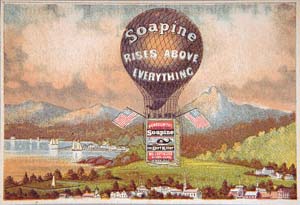
Soapine Rises Above Everything

Date unknown
Advertisement, 7 x 10.5 cm.


This advertisement is another example of the use of aeronautical themes to advertise commercial products. A box of Soapine, a laundry product made by Kendall Mfg. Co. in Providence, R.I., rises in a balloon over a town surrounded by mountains, trees, and a lake. The reverse of the ad reads: "For Washing and Cleaning Everything, No Matter What, Soapine Works, Quicker, Easier, Cheaper and Better Than Soap or Anything Else."


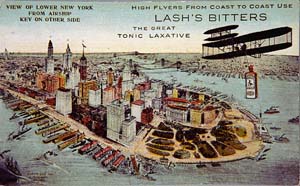
High Flyers from Coast to Coast Use Lash's Bitters, The Great Tonic Laxative

ca. 1911
Advertisement, 8.5 x 13.5 cm.


After the first successful powered heavier-than-air flight by the Wright brothers in December 1903, manufacturers began to use aircraft to advertise their products. This advertisement postcard depicts what looks like a Wright Model A in flight over Manhattan, carrying a bottle of Lash's Bitters. Although barely visible, numbers on the front of the postcard refer to early twentieth-century Manhattan landmarks like the Woolworth Building, Banker's Trust Building, and the Brooklyn Bridge.


Dime Novels

“The dime novel,” as Russel Nye has observed, sprouted in the eighteen-forties and fifties, flowered in the sixties and seventies, and drooped and died at the turn of the century.” Nevertheless, this form of popular fiction had a strong attraction for young men during the half-century of its popularity. Although many stories were Westerns, others, Nye points out, “covered the Revolution, the War of 1812, the Mexican War, and the Civil War; they used pirate stories, sea stories, city stories of high and low life, crime stories, bandit stories, stories of exploration, adventure, history, love, romance.” The writing was formulaic and the characters often coarse, but the stories stressed virtuous behavior. As time went on, however, the emphasis turned to “sensationalism, violence, and overwrought emotionalism.” Some stories included balloons, airships, and imaginative flying machines as drama-heightening devices, and the colorful cover art focused on these situations. It is quite possible that the adventures of dime-novel heroes like Frank Reade, Jr., motivated the first generation of pilots. The situations in these stories presaged the use of aviation in films, pulp novels, and radio serials. The editions presented were published between 1897 and 1910.



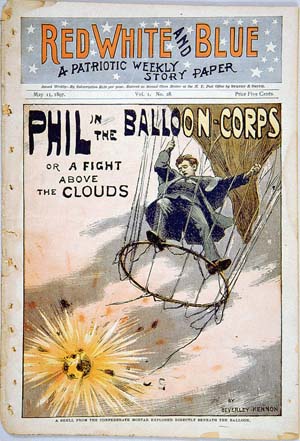
Beverly Kennon.  "Phil in the Balloon Corps; or, A Flight Above the Clouds."  Red, White and Blue: A Patriotic Weekly Story Paper.  May 15, 1897.  Vol. 1, No. 28.  New York:  Street & Smith [ca. 1897]

Dime novel, 27 p. illus.
XA-2-2D


The exciting cover text ("A shell from the Confederate mortar exploded directly beneath the balloon") and illustration announce another number in the Red, White and Blue Library of Street & Smith. In his book on Street & Smith, Quentin Reynolds observes that the Red, White and Blue Library was "designed to cater to the spirit of patriotism presumably inherent in the breast of every red-blooded American boy. The stories were alternately about two boys, Ralph in the navy and Phil in the army. These two youngsters performed military and naval feats never dreamed of by the experts, and they were at all times ready to cry, 'Hurray for the Red, White and Blue.'"The Red, White and Blue Library began in 1896 and lasted a year.


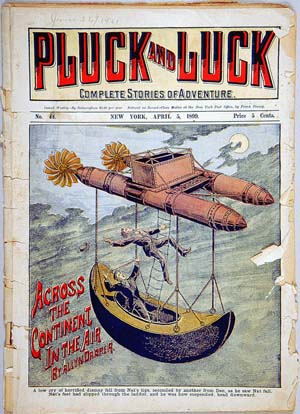
Allyn Draper.  "Across the Continent in the Air."  Pluck and Luck:  Complete Stories of Adventure.  April 5, 1899.  No. 44. New York:  Frank Tousey, [ca. 1899]

Dime novel, 31 p. illus.

The heroes of the story, Nat Nimmo and Dan Taylor, undertake a cross-country odyssey in an aerial conveyance, which Nat has invented. The flying vehicle, with an upper part shaped like a catamaran and a lower part shaped like a canoe, is driven by a "powerful, reciprocating electrical engine" and is called the "Rocket." In dime-novel fashion, the cover depicts a typical hair-raising scene. One character dangles head downward from the rope ladder that connects the two parts of the vehicle, while the other stands by helplessly. The boys free themselves from this dilemma, but more adventures await them on their journey.


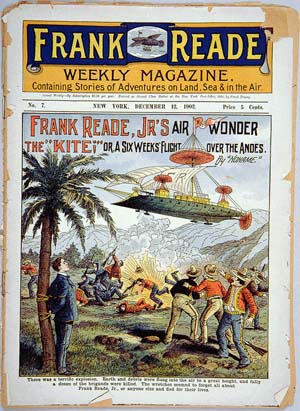
"Frank Reade, Jr.'s Air Wonder, 'The Kite'; or, A Six-Weeks' Flight over the Andes."  Frank Reade Weekly Magazine [Containing Stories of Adventures on Land, Sea and in the Air].  December 12, 1902.  No. 7. New York:  Frank Tousey, [ca. 1902]

Dime novel, 28 p. illus.
XA-3-3A

The colorful cover illustration depicts the hero, Frank Reade, Jr., tied to a tree somewhere in the Andes, while an airship called the "Kite" flies overhead. The cover text ("There was a terrific explosion.  Earth and debris were flung into the air to a great height, and fully a dozen of the brigands were killed. . .") alerts the reader to the exciting climax when the hero is rescued by the airship. At the end of the story, Frank Reade, Jr., drops bombs from the Kite onto his enemies, driving them "like sheep from their hiding places" and scattering them "like chaff before the wind."


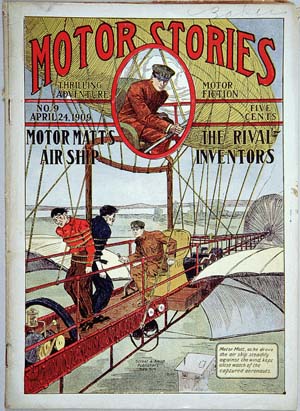
"Motor Matt's Air Ship, or The Rival Inventors."  Motor Stories [Thrilling Adventure Motor Fiction].  April 24, 1909. No. 9.  New York:  Street & Smith, [ca. 1909]

Dime novel, 31 p. illus.

"Motor Matt," the hero of this Motor Series Library, "is simply a youth who has considerable training in a machine shop where motors of all kinds were repaired, and who is possessed of a genius for mechanics." The titles of the other editions in the series suggest that Matt's adventures involve automobiles, but here, he and the villains use an airship to heighten the dramatic effect of the story.


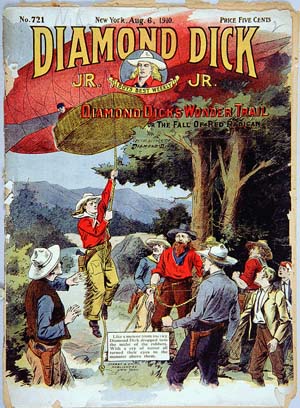
"Diamond Dick's Wonder Trail or, The Fall of Red Radigan."  Diamond Dick, Jr.: Boys Best Weekly. August 6, 1910. No. 721. New York:  Street & Smith,
[ca. 1910]

Dime novel, 31 p. illus.

Diamond Dick, Jr., ostensibly a Western hero, was the fictional son of Diamond Dick, one of the most successful characters in the Street & Smith dime-novel empire. On occasion, Diamond Dick, Jr., used aerial vehicles of one kind or another to thwart his antagonists.  In this 1910 adventure, the hero's flight in a balloon sends "thrills through his being" and is "the most wonderful of all" his adventures. In the story's climax, he drops from the sky to frustrate the highwaymen's attempts at robbery.


Excerpts from Newspapers and Periodicals


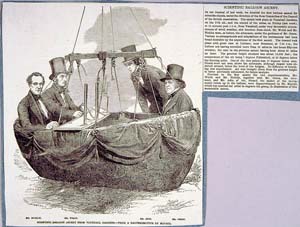
Scientific Balloon Ascent. Poss. from London Illustrated News, [1852?] with engraving

Clipping, 25 x 18.5 cm.


The illustration, adapted from a daguerreotype by a "Mr. Mayall," depicts a scientific balloon ascent from Vauxhall Gardens in Charles Green's balloon the Nassau. The figures are, from left to right, Mr. Nicklin, Mr. Welsh, Mr. Adie, and Charles Green himself, one of Great Britain's most famous balloonists. This was the second in a series of four balloon ascents undertaken by Green "for scientific objects, under the direction of the Kew [Observatory] Committee of the Council for the British Association."  Mr. Welsh and Mr. Nicklin, presumably of the Kew Committee, were the aeronauts, under Green's direction. Mr. Adie made the scientific instruments taken on the voyage. The ascents attained heights of 12,640 to 22,930 feet.


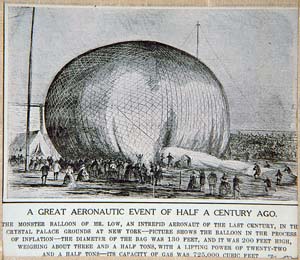
A great aeronautic event of half a century ago.  1909

Clipping, 8 x 11 cm.
XF-1-1  2375


The clipping depicts Thaddeus Lowe's "monster balloon," The City of New York (later called the Great Western), being inflated on the grounds of the Crystal Palace in New York. Lowe had constructed the balloon, which had a diameter of 130 feet, weighed 3.5 tons, and could hold 725,000 cubic feet of gas, for the purpose of crossing the Atlantic. Tom Crouch, in The Eagle Aloft, observes that the inflation of such a gigantic balloon was not without problems and that at the slow rate at which gas was being pumped into it "the Great Western would never be inflated." The gas, Crouch writes," was now escaping from the envelope faster than the gasworks could pump it without blacking out the city." Lowe accepted an offer to take the airship to Philadelphia, "but realized that the season was now too far advanced to attempt a crossing before spring." Finally, he put the large balloon in storage and went to Charleston, South Carolina, where he "spent the winter in ascending and studying various air currents" using his smaller lighter-than-air craft.


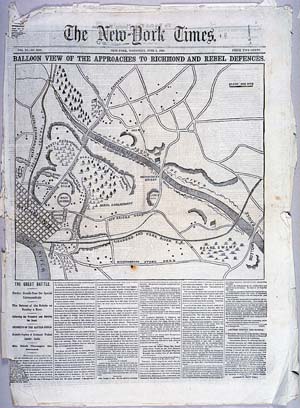
Balloon view of the approaches to Richmond and Rebel defences.  Front page with map from the New York Times for June 5, 1862

Clipping, 30 x 34.5 cm.

This aerial map, which appeared on the front page of the New York Times for June 5, 1862, was presumably drawn in an observation balloon launched by Thaddeus Lowe during the Peninsular Campaign of the Civil War. It shows the approaches to Richmond, capital of the Confederacy, and the rebel encampments between the Chickahominy River (runs diagonally from top left to bottom right) and the city. The account discusses Lowe's role in observing the area and relaying that intelligence to Washington: "Prof. Lowe has made two ascensions since sunrise, and made minute reports of his observations, which have been telegraphed to headquarters, the apparatus for that purpose having been brought upon the ground and put into operation yesterday. Notwithstanding the telegraph facilities, orderlies are continually arriving at the balloon headquarters, for the purpose of conveying important dispatches to the commanding Generals."


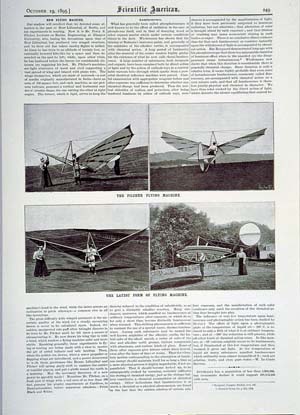
New Flying Machine [of Percy S. Pilcher], 1895.  Scientific American, October 19, 1895, p. 249

Clipping, 41 x 28.5 cm.
XE-2-1 3282

Scientific American, founded by Rufus Porter (a famous American airship pioneer), was the first periodical in the United States to take seriously the efforts of the aerial experimenters. In the October 19, 1895, issue the magazine featured the work of the English experimenter Percy S. Pilcher, Otto Lilienthal's leading disciple.  Pilcher's work was also influenced by Octave Chanute, a colleague of the Wright brothers. The article contains two illustrations of the Pilcher machine. "Mr. Pilcher's machines," the article points out, "are light structures of wood and steel supporting a vast spread of wing and braced with piano wire. The wings themselves, which are made of nainsook—a sort of muslin originally manufactured in India—have an area of 150 square feet;  and each machine, as our pictures indicate, possesses a vertical and horizontal rudder of circular shape, the one cutting the other at right angles. The former, which is rigid, serves to keep the machine's head to the wind, while the later arrests an inclination to pitch sideways—a common vice in all like inventions.


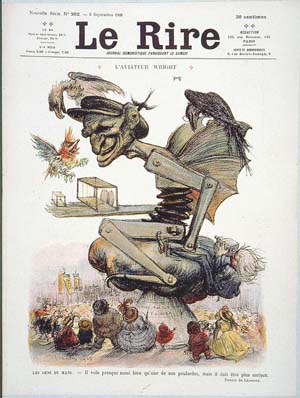
L'Aviateur Wright.  Le Rire: Journal humoristique Paraissant le Samedi, 5 Septembre 1908

Magazine cover (with illustration), 23.5 x 30.5 cm.
TLB157.G8

The cover illustration from Le Rire illustrates the public's fascination with Wilbur Wright during his demonstration flights in France in 1908. The form depicted suggests that the French ascribed bird- or bat-like and machine-like qualities to Wilbur for his exceptional displays of flying. As Robert Wohl has pointed out, the French public "read about his exploits and flocked by the thousands to see his flights. They bought postcard images of his profile, rendered appropriately bird-like, and replicas of his green cap. . . . They sang songs about or inspired by him. They consumed an unending stream of newspapers and magazines that bore his portrait and recounted anecdotes about his eccentricities. . . . They quoted with delight his outrageously un-Gallic statement... 'The only birds who speak are parrots; they can't fly very high.'"


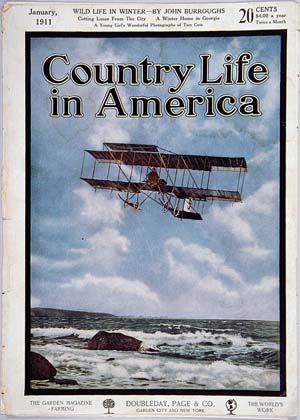
Philip W. Wilcox.  "The New Sport of Flying;  the First Flight of an Amateur Aviator."  Country Life in America, January 1911, p. 265

Clipping (with cover illustration), 35 x 25 cm.
XE-6-3   3360


Wilcox's remarkably candid article illuminates the sport flying movement in the United States before World War I. The author provides the reader with vivid impressions of the "sensation of unlimited space and freedom, which is never more impressive than during an aeroplane flight." "Space," he writes, "seems to be without limit as the machine plunges up and down at the will of the operator. The swerving from side to side at the slightest movement of the rudders;  the tipping sidewise of the planes at every cross current and gust of wind, and finally the variation of the forward velocity of the machine, as it goes up or down, all add to this sensation." But Wilcox does not dismiss the danger: "The strain on the nerves [during the flight] had been tremendous, and although everything had turned out about as expected, the suddenness with which things took place was most alarming." Wilcox goes on to say that perfect weather conditions gave him ample time to react to situations and saved him from injury.


Handbills, Circulars, and Leaflets


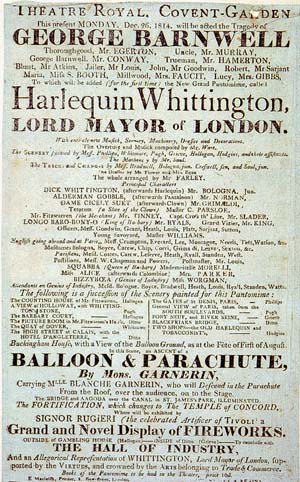
Ascent of a Balloon & Parachute, By Mons. Garnerin, carrying Mlle. Blanche Garnerin, who will Descend in the Parachute From the Roof, over the audience on to the Stage.  E. Macleish, Printer, London

Handbill, 24 x 15.3 cm.
XL-21  2104a

André Jacques Garnerin, a Frenchman, was the first aeronaut to make a parachute jump from a balloon. He also made the earliest significant ascents in England during the early nineteenth century, the first of which took place on June 28, 1802, in London. The handbill refers to an ascent in 1804 made by Garnerin and a parachute jump made by his wife at Covent Garden. In attendance was Harlequin Whittington, Lord Mayor of London.


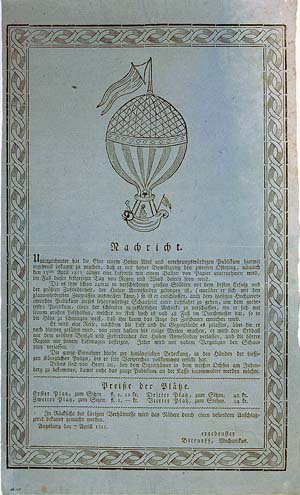
Nachricht [Notice].  Unterzeichneter hat die Ehre . . . Augsburg, 1811

Letterpress on blue paper, 36 x 21.5 cm.
XL-21  2116

This broadside advertises the ascent of H.(or Sebastian) Bittorf (sometimes "Bittdorf," here "Bittorff") from Augsburg. On July 16, 1812, Bittorf perished during his thirtieth ascent, from Mannheim, his hometown.  A Madame Bittorf, no doubt connected to him, also made ascents in Germany.


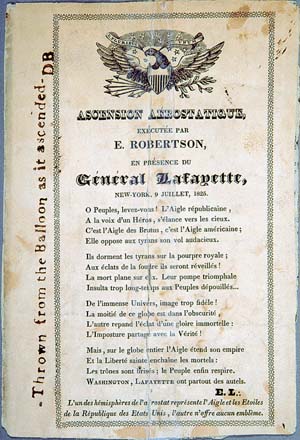
Ascension Aérostatique, Exécutée par E. Robertson en Présence du Géneral Lafayette. . .

Handbill, 12.5 x 18.5 cm

This handbill announces a flight in honor of the Marquis de Lafayette on July 9, 1825; Eugène Robertson flew from Castle Garden, a pleasure garden located on a small island west of the Battery in New York City. According to Tom Crouch, in The Eagle Aloft, Robertson, a Frenchman, and member of one of the great ballooning families of Europe, "planted the seed of an American aerostatic tradition" during his tours of the United States. The poem speaks of flight and democracy, the overthrow of tyrannical government, and the heroism of Lafayette and George Washington.


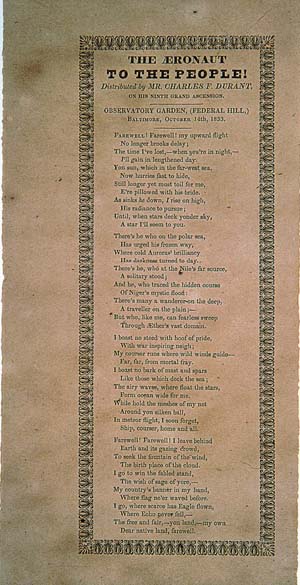
The Aeronaut to the People!  Distributed by Mr. Charles F. Durant. . . October 14, 1833

Letterpress, 30 x 12.2 cm.
XP-XL-26   2183

This handbill was designed to be dropped from the balloon in which Charles Ferson Durant made his ninth American ascent from Baltimore on October 14, 1833. It contains a long poem in which the poet (uncredited) reflects on leaving earth behind and traveling on the ocean of air. After training in France, Durant had begun making ascents from New York in 1830. He was on the road in 1833 and made ascents in Baltimore on September 26 and October 14. Though Durant retired in 1834 after only thirteen flights, he was important in the history of American ballooning. According to Tom Crouch in The Eagle Aloft, Durant “fixed the image of the daring aeronaut in the minds of the American public.”


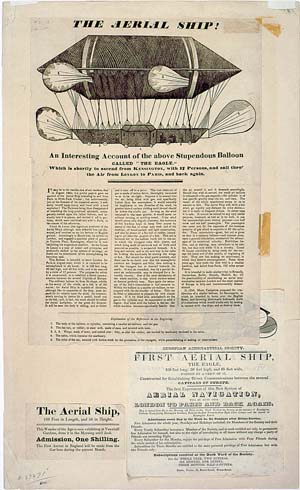
The Aerial Ship!  An Interesting Account of the above Stupendous Balloon called "The Eagle" . . . [1835]

Letterpress with wood engraving, 35.6 x 25.5 cm.

Comte de Lennox created this dirigible, which he constructed in 1835 and hoped to fly to Paris from London in six hours, an event that the text of the article announces for the coming August. The dirigible was to be "a direct communication between the several Capitals of Europe." The design includes a bladder contained within the envelope, which would be filled with compressed air and serve as a ballast—an idea dating almost to the invention of the balloon but probably reinvented by the Count. The paddles on the sides of the envelope were to be worked by "machinery" contained within the central cabin, although we can assume that the motive force was provided by the arms of the ten crew members. The Count's tenacity is to be lauded, for in the previous year (1834) he had built another airship, which had been destroyed by the crowd when, following a mishap, the ascent was postponed. The 1835 aircraft was built and exhibited but never flown. Gimbel apparently purchased the item already mounted with two other advertisements for The Eagle.


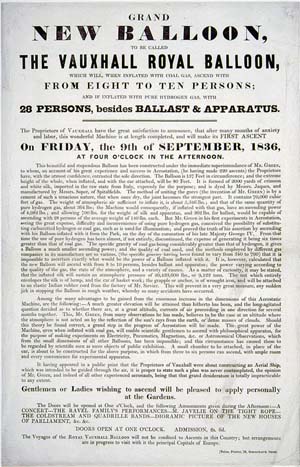
Grand New Balloon, to be called Vauxhall Royal Balloon. . . first ascent on Friday, the 9th of September, 1836. Printed by Balne, 38 Gracechurch Street, [London]

Letterpress, 37.4 x 34.2 cm.
XP-XL-12    1404

This broadside describes the many virtues of the Vauxhall Royal Balloon, whose large capacity would allow it to ascend to hitherto unattained heights and seek out "currents of air proceeding in one direction for several months together." If such currents were discovered, "a grand step in the progress of Aerostation will be made. The text disclaims the rumor that the balloon would be steerable: "Such a plan was never contemplated... the opinion of Mr. Green. . . being that great desideratum is totally impracticable to any extent." The operator of the Vauxhall Royal, Charles Green, was one of the most famous of the Victorian-era English balloonists.


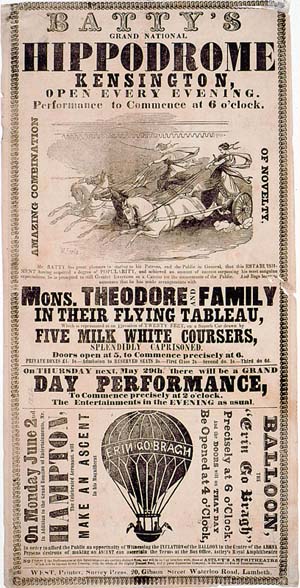
Batty's Grand National Hippodrome, Kensington.  With woodcut of balloon, 11 cm., printed by West, 20 Gibson Street, Waterloo Road, Lambeth, London

Handbill, 49.5 x 24.1 cm.
XP-XL-11    1372

This handbill illustrates how the word "flying" was used to attract customers to circus entertainment in the nineteenth century.  Conversely, it shows how balloon ascents in a setting like the Hippodrome in the Kensington section of London could become part of the entertainment fare of the day. The hippodrome, an arena for equestrian performance in nineteenth-century parlance, was fashioned after the oval stadium in ancient Greece, which was used for horse racing and chariot racing.

The upper part of the handbill depicts "Mons. Theodore and family in their flying tableau, Which is represented at an Elevation of TWENTY FEET, on a Superb Car drawn by Five Milk White Coursers Splendidly Caprisoned."  The lower part announces, "On Monday June 2nd. In Addition to the Grand Routine of Entertainments, Mr. Hampton, The Celebrated Aeronaut, will Make an Ascent In his Magnificent Erin Go Bragh."


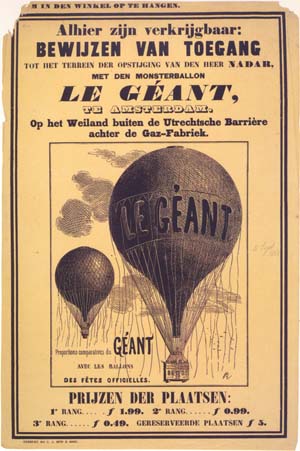
Alhier zijn verkrijgbaar:  bewijzen van toegang tot het terrein der opstijging van den Heer Nadar, met den monsterballon Le Géant, te Amsterdam... 11 Sept. 1865.    [Amsterdam, 1865?]

Letterpress with line block illustration, on yellow paper, 47.8 x 31.8 cm.
XP-XL-13   1467

This poster advertises the flight of Le Géant from Amsterdam in September 1865. Le Géant was constructed by the photographer Nadar (Gaspard-Félix Tournachon) to finance research into heavier-than-air flight, which he believed to be the only viable way of navigating the air. He organized a society (which included Victor Hugo, Alexander Dumas, Sr., Alexander Dumas, Jr., and Jules Verne), published a Manifesto in 1863, and began the publication of the periodical L'Aéronaute. On October 9, 1863, Le Géant ascended from Paris with fifteen people; its large car was equipped with a lavatory and carried a printing press and photographic darkroom. The first flight ended abruptly at Meaux, about 30 miles from Paris. The next flight—on October 18—transported nine people to Hanover in 16 hours. This trip was noted for its disastrous landing, in which the balloon was dragged across the country for 6 or 7 miles. Nadar later made ascents at Brussels, Lyons, Amsterdam, and Paris but never succeeded in raising any money with the balloon.


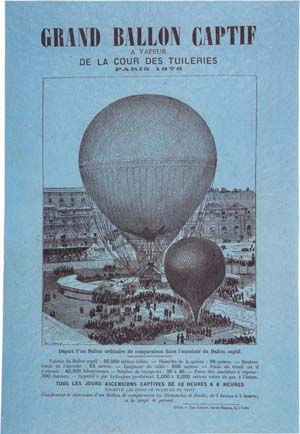
Grand Ballon captif à vapeur de la Cour des Tuileries Paris 1878.  Paris, Typ. Lahure, [1878?]

Handbill, 24 x 19.2 (borderline) on 41 x 26.6 cm. sheet
XE-5-3   3294

This handbill was a souvenir from a 1300- to 1800-foot-high flight of a gigantic tethered balloon designed and constructed by Henri Giffard, during the Paris World Fair. Giffard, a brilliant engineer, had built and flown the world's first successful powered dirigible balloon on September 24, 1852. The enormous Grand Ballon held 883,000 cubic feet of hydrogen and could lift 27 tons. It was raised above the city and brought back to earth by means of a steam winch. The balloon's particulars were recorded by Gaston Tissandier, himself a well-known balloonist, in Le grand ballon captif à vapeur de M. Henri Giffard, a rare item in the Gimbel collection.


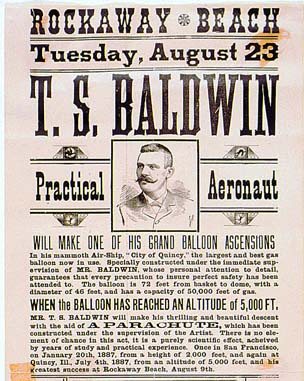
T.S. Baldwin, practical aeronaut, will make one of his grand balloon ascensions in  his mammoth air-ship "City of Quincy," Tuesday, August 23 [1887?].  New York.  Richard K. Fox, Show Printer and Engraver, Franklin Square, New York

Handbill, 55 x 20.5 cm.
XL-30 2699

This handbill advertises T. [Thomas] S. Baldwin's balloon, the City of Quincy, as "the largest and best gas balloon now in use" and explains that it is "Specially constructed under the immediate supervision of MR. BALDWIN, whose personal attention to detail guarantees that every precaution to insure perfect safety has been attended to." The City of Quincy was 72 feet from basket to dome, had a diameter of 46 feet, and could hold 50,000 cubic feet of gas. The flight, which took place on August 23, 1887, was one of a series that Baldwin made at Rockaway Beach in Queens, New York City, and included a parachute jump from 5,000 feet. A few months earlier, on January 30, at Golden Gate Park in San Francisco, before a crowd of 30,000 people, Baldwin had made the first successful parachute jump on record from a height of 1,000 feet. Baldwin was one of America's most famous aeronauts.


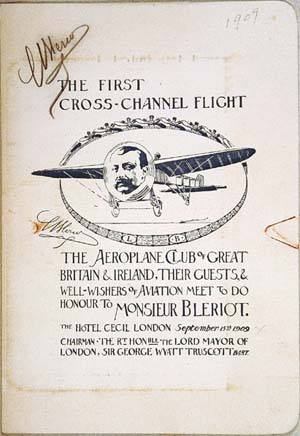
The Aeroplane Club of Great Britain & Ireland. . . meet to do honour to Monsieur Bleriot. . . September 15, 1909

Handbill, 9 x 13 cm.
TLB157.G8

A few months after Louis Blériot's historic flight over the English Channel in July 1909, the Aeroplane Club of Great Britain & Ireland met at London's Hotel Cecil to honor Blériot and celebrate his accomplishment. Underneath such typical shows of enthusiasm, however, lay another reality. Blériot's flight brought with it the recognition that England's vaunted insularity could be breached. The French realized this too. Gaston Calmette, editor of Le Figaro, observed, "What will become of men's laws, their customs barriers, the vain efforts of their industrial protectionism, their commercial exchanges, their defenses, their relations, their intercourse, on the day when man can, by the action of his will alone, pass in a few hours beyond all horizons across all the oceans and above all the rivers. . . ." Before long, Lord Northcliffe, whose Daily Mail had sponsored the prize money for the Channel crossing, began a campaign to convince the British government of the necessity of the speedy development of a military air arm, an action Alfred Gollin has called "the beginning of air power politics in Britain."


Post Cards


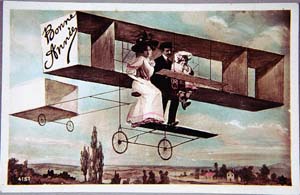
[Woman, man, and child sitting in airplane with greeting "Bonne Année"]  [1908?]

Postcard, 9 x 14 cm.


This postcard reflects popular European interest in aeronautics in the early twentieth century. The greeting is in French ("Happy New Year"); the man, woman, and child are sitting in a Voisin-like aircraft.


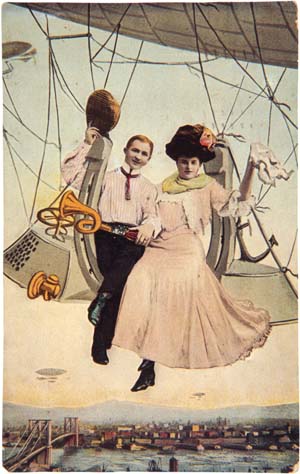
[Man and woman sitting in airship gondola] Postmark, New York, N.Y., June 25, 1909

Postcard, 8.5 x 13.5 cm.

This postcard reflects popular American interest in aeronautics in the early twentieth century. The couple sits in an airship gondola above New York City. The Brooklyn Bridge is at bottom left.


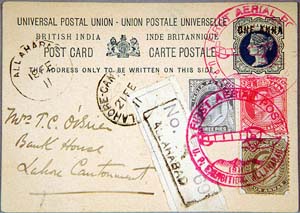
Universal Postal Union, British India, Post Card, February 18, 1911, First aerial post, U.P. Exhibition, Allahabad

Postcard, 8.5 x 12 cm.


This postcard was carried on the world's first official airmail flight by airplane—from Allahabad, India, as part of the United Provinces Industrial and Agricultural Exhibition held in February 1911. After a short flight from Allahabad (postmark February 18, 1911) to Naini, the postcard was conveyed to Lahore (postmark February 21, 1911).


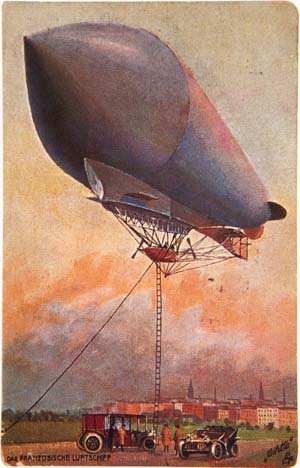
Das französische Luftschiff [The French airship].  Postmark, Brooklyn, New York, June 28, 1911

Postcard, 9 x 14 cm.


This postcard depicts the Lebaudy-type airship La Patrie, built for the French army in 1906. The airship was the largest of its time, more than 200 feet long, with a capacity of 111,250 cubic feet. On maneuvers at Verdun in 1907, while the airship was tied to the ground, a tremendous windstorm arose. Two hundred men labored unsuccessfully to hold the ship down and keep it from being blown away. The giant airship broke free, sailing over France, England, Wales, and part of Ireland, and disappeared over the Atlantic.


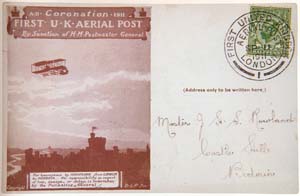
First U.K. Aerial Post, Coronation, A.D. 1911, By Sanction of H.M. Postmaster General

Postcard, 9 x 14 cm.


This postcard (postmark September 11, 1911) was carried on the airpost flights between London and Windsor as part of a celebration of the coronation of H.M. King George V. These airmail flights are commonly known as the British Coronation Aerial Post.


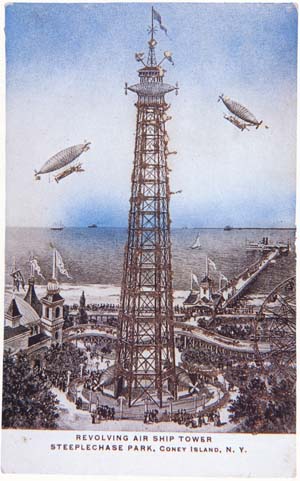
Revolving Air Ship Tower, Steeplechase Park, Coney Island,  N.Y., undated and unaddressed

Postcard, 8.75 x 14 cm.


This postcard depicts an amusement park ride—a revolving air ship tower constructed at Steeplechase Park—that reflected popular interest in aeronautics at the end of the nineteenth century and the beginning of the twentieth. Steeplechase Park was one of three amusement areas that opened between 1897 and 1905 at Coney Island in Brooklyn, New York.


Programs


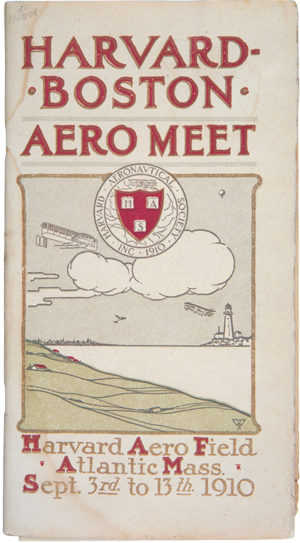
Harvard-Boston Aero Meet.  Harvard Aero Field, Atlantic, Mass. Sept. 3rd to 13th, 1910

Program,  12.4 x 22.7 cm.
TLC71.H 33 1910


The Harvard-Boston Aero Meet took place September 3-10, 1910, in the village of Squantum, southeast of Boston. It was the first large air meet in the eastern United States; more than $90,000 in prizes and appearance fees were offered. Ten thousand dollars of that sum was paid to the British aviator Claude Grahame-White for winning a 33-mile race over land and water around Boston light, an event that Wilbur Wright and Glenn Curtiss thought too dangerous to compete in.


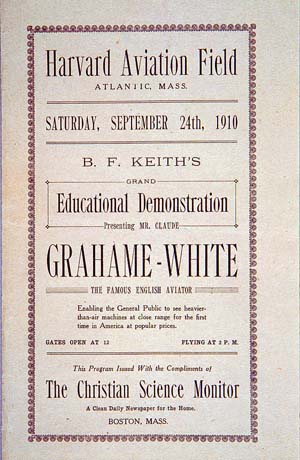
Educational Demonstration Presenting Mr. Claude Grahame-White, The Famous English Aviator, Harvard Aviation Field, Atlantic, Mass., September 24, 1910.  Issued with the compliments of the Christian Science Monitor
Program,  24 x 14.5 cm.

A group of Bostonians offered Claude Grahame-White, one of Great Britain's foremost early aviators, $50,000 plus expenses to come to the United States to participate in the Boston-Harvard Aero Meet (September 3-13, 1910). After the meet, B.F. Keith, a showman, sponsored a special demonstration on September 24, 1910, in which Grahame-White flew a Blériot monoplane and a Farman biplane. The program featured aerial stunts, including Grahame-White's attempts to dive from 4,000 feet with a dead engine and to beat the world altitude record of 8,000 feet.


Sheet Music

Early twentieth-century American popular music, a product intended for commercial mass market distribution, often reflects its social and cultural surroundings. Because this was a time when new inventions and discoveries were having a profound effect on society, it is not surprising that popular music of the day would use the airplane as thematic material. Many aeronautical songs written in the early twentieth century are concerned with the airplane’s mobility (especially compared with other forms of transportation like the automobile) and escape (for example, the fanciful notion that the flying machine can carry passengers into outer space). The titles presented are primarily early twentieth-century American compositions. However, Icare, a French sonnet set to music, and Aeroplane, or flying machine, a British waltz dedicated to Samuel F. Cody, reflect popular European interest in the subject.


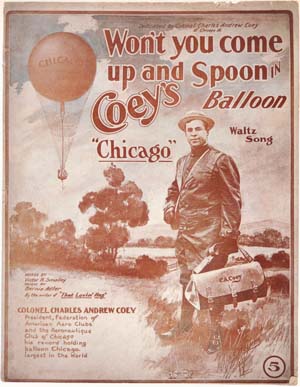
Won't You Come Up and Spoon in Coey's Balloon.  Words by Victor H. Smalley.  Music by Bernie Adler.  Chicago: Smalley & Adler, 1908

Sheet music, 5 p., 28 x 35.5 cm.
XK-24-2   3420


The title of the song refers to the balloon Chicago, which belonged to Charles Andrew Coey, president of the Federation of American Aero Clubs and the Aeronautique Club of Chicago. According to Tom Crouch in The Eagle Aloft, the Chicago "stood ten stories tall and was perhaps the largest envelope flown in the United States" during the first decade of the twentieth century.


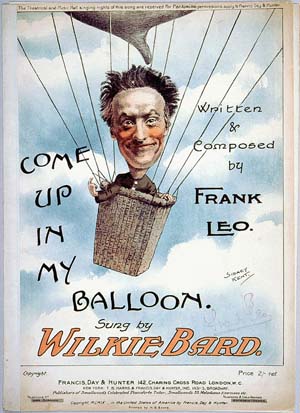
Come Up in my Balloon.  Written and composed by Frank Leo.  Sung by Wilkie Bard. London:  Francis, Day and Hunter, 1909

Sheet music, 4 p., 26 x 36 cm.
XK-24-2   3427


Come Up in My Balloon is an early twentieth-century song that compares aerial conveyances with other forms of transportation (motors, sailing yachts and floaters, and electric omnibuses) but opts for the joy of flying ("Give me aer-ial nav-i-ga-tion, I am caus-ing a sen-sa-tion With my cheap bal-loon excursions up to Mars").


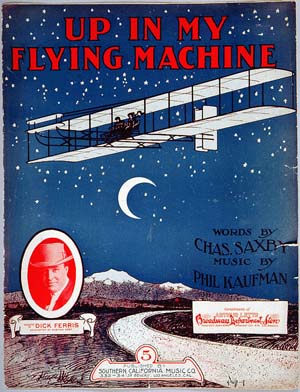
Up in My Flying Machine.  Words by Charles Saxby.  Music by Phil Kaufman.  Los Angeles:  Southern California Music Co., 1910

Sheet music, 5 p., 27 x 36 cm.
XK-24-2   3686


This 1910 song was dedicated to Dick Ferris, originator of the Los Angeles Aero Meet at Dominguez Field in 1910. Like other aeronautical songs of the period, it begins with lyrics about the automobile ("with a chauf-feur smart and a gas go cart and a coup-le of extra ti-res") but quickly focuses attention on the airplane, which enables one to escape earth's boundaries and leave the clouds far below as "on the trails of air we go."

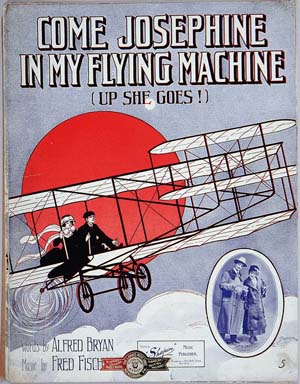
Come Josephine in My Flying Machine  (Up She Goes!).  Words by Alfred Bryan.  Music by Fred Fischer.  New York:  Maurice Shapiro, 1910

Sheet music, 5 p., 26 x 34.5 cm.
XK-24-2   1536


Come Josephine in My Flying Machine (Up She Goes!) has been called the most popular aeronautical song ever written and often appears as background music in films about early aviation. Its connection with popular songs about the telephone (Hello Central, Give Me Heaven by Charles K. Harris) and the automobile (In My Merry Oldsmobile by Vincent P. Bryan and Gus Edwards) indicates that late nineteenth- and early twentieth-century technologies were favorite topics for tunesmiths.


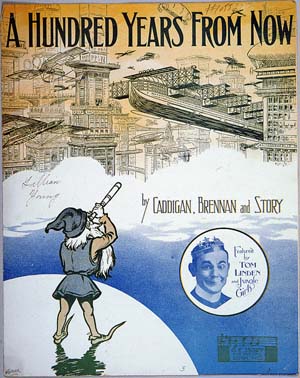
A Hundred Years from Now.  By Caddigan, Brennan and Story.  Boston: O.E. Story, 1914

Sheet music, 5 p., 27 x 34 cm.
XK-24-2   1539


This 1914 sheet music cover depicts a gnomelike figure gazing through a spyglass at a fanciful city beyond.  The city, a projection of what life might be like in 2014 (as the song's title suggests, "A Hundred Years from Now"), shows more than a dozen flying machines, including what looks like a huge aerial yacht. Although there is no mention of flying machines in the song's lyrics, there is speculation about the pace of life a century into the future: "I won-der what kind of a life they'll lead a hun-dred years from now?  I won-der what's go-ing to be the speed A hun-dred years from now."


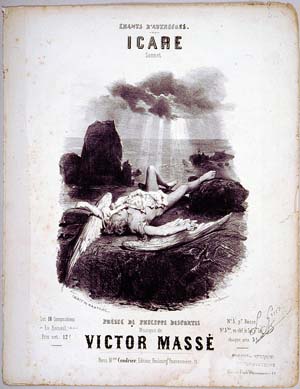
Icare.  Poésie de Philipe Desportes.  Musique de Victor Massé  Paris: Cendrier [ca. 1840?]

Sheet music, 5 p., 27 x 35 cm.
XK-24-2   1556


This French sonnet (literally, "little song") is based on the Greek legend of Daedalus and Icarus. It is, as Charles Gibbs-Smith has pointed out in Aviation: An Historical Survey, "the modern airman's legend par excellence." Having constructed the Cretan labyrinth for King Minos, Deadalus, an inventor and patron of craftsmen and artists, incurred the King's wrath.  To escape from Crete, he constructed wings fastened with wax for his son Icarus and himself. Daedalus warned Icarus not to fly near the sun.  Icarus disobeyed, and the sun melted the wax that anchored his wings, causing him to plunge to his death in the sea. The sonnet is an Italian verse form consisting of fourteen lines, typically of iambic pentameter in English, or alexandrine (iambic hexameter) in French, rhyming to a determined scheme. The illustration shows the dead or dying Icarus lying on rocks, while streams of light pass through ominous dark clouds.


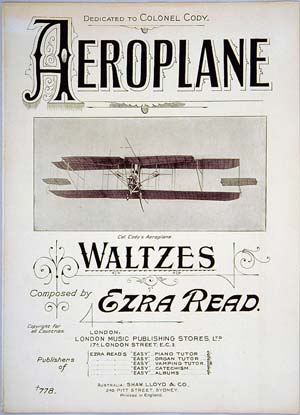
Aeroplane.  By Ezra Read.  London:  Music Publishing Stores, Ltd., no date

Sheet music, 7 p., 26 x 35.5 cm.
XK-24-2   1555

This waltz-tempo composition is dedicated to Colonel Samuel F. Cody, a photograph of whose aircraft is on the cover.  Cody was a flamboyant Texan who had been a cowboy, gold prospector, and Wild West showman. On October 16, 1908, he made the first officially recognized heavier-than-air flight in Great Britain in his British Army Aeroplane No. 1 at the Farnborough Balloon Factory.


Tickets


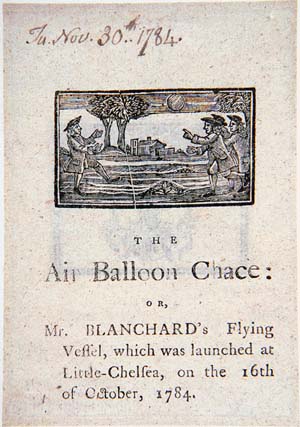
The Air Balloon Chace:  or, Mr. Blanchard's Flying Vessel, which was launched at Little-Chelsea, on the 16th of October, 1784

Engraving, 9.5 x 13.5 cm.
TLB 276.B6

The illustration and text on the ticket refer to a balloon flight made by Jean-Pierre Blanchard and Dr. John Sheldon, an anatomist, on October 16, 1784. This flight, which took place at Lochee's Military Academy, was attended by 250,000 spectators, some of whom arrived in approximately 2,000 carriages. Blanchard and Sheldon made three attempts before ascending successfully.  J.E. Hodgson described the voyage in The History of Aeronautics in Great Britain: "Having cleared the neighbouring buildings, a north-westerly breeze carried the balloon... over Hammersmith, Chiswick, and Twickenham, from which point the descent was gradual, until a landing was made near the seat of Lord Vere at Sunbury." Here Sheldon got down from the balloon, and Blanchard continued alone, landing at Romney, 73 miles from London. The handwriting on the ticket refers to a balloon flight made by Jean-Pierre Blanchard and John Jeffries on Tuesday, November 30, 1784.


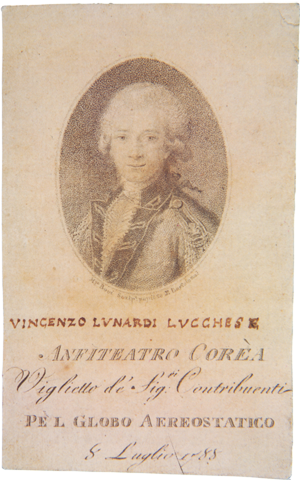
Vincenzo Lunardi Lucchese, Anfiteatro Corèa, Viglietto de' Sig.ri Contribuenti, pè l globo aereostatico, 8 Luglio 1788

Ticket with engraving, 11.5 x 7.5 cm.
XB-7-11  2806

This engraved ticket, which contains a portrait of Lunardi, was issued for a July 8, 1788, ascension, although there is no indication as to where the flight took place. Lunardi, an Italian reportedly born in Lucca on January 11, 1759, was secretary to the Neapolitan ambassador to the Court of St. James. He made the first manned balloon flight in Great Britain on September 15, 1784, and quickly established himself as one of Europe's most famous aeronauts. He died on a tour of Portugal on July 31, 1806, at the age of forty-seven.


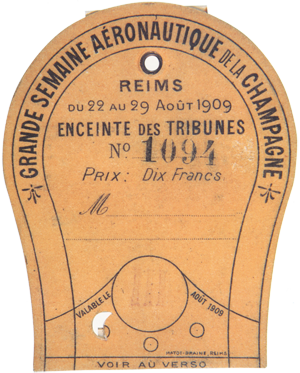
Grande Semaine Aéronautique de la Champagne [The Champagne region's great aviation week], Reims, du 22 au 29 Août 1909

Ticket, 7 x 9 cm.
TLB157.G8

This cork-shaped ticket admitted the bearer to the world's first air meet held at Reims, France, from August 22 to August 29, 1909. Sponsored by the city of Reims and France's most renowned champagne houses, each of whom contributed 200,000 francs for prizes in speed, distance, altitude, and passenger carrying. James Gordon Bennett, American sportsman, expatriate, and publisher of the New York Herald and its European edition, the Paris Herald, donated the most prestigious award, the Coupe Internationale d'Aviation (International Aviation Cup, or Gordon Bennett Cup), a silver trophy that was presented along with 25,000 francs in cash.
 
Although marred by rain and mud, the Reims meet played host to the most famous names in French aviation manufacturing, including Voisin, Blériot, Farman, Antoinette, and the American aviator Glenn Curtiss, and was attended by the elite society of France and America. On the next-to-last day of the meet, Curtiss thrilled the crowd of spectators by beating Louis Blériot for the Gordon Bennett Cup by 6 seconds.


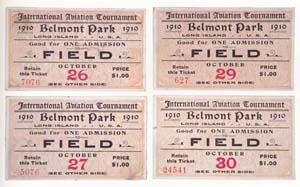
International Aviation Tournament, 1910, Belmont Park, Long Island, U.S.A., Good for One Admission to Field [October 26, 27, 29, 30]

Ticket, 11 x 6.5 cm.
XB-7-11  2830, 2831, 2832, 2833


These tickets admitted the holder to the air meet held at Belmont Park Race Track on Long Island in October 1910. The meet's main event was the 100 kilometer (60-mile) Gordon Bennett Cup Race on October 29, won by Britain's top pilot Claude Grahame-White, with a time of 61 minutes, 4.74 seconds. This was the second time the trophy would be awarded (the first was at Reims in 1909) and the first time it was given in America.
The final event of the meet, a 33-mile race across New York City to the Statue of Liberty and back, evoked a bitter dispute.  John Moisant was declared the winner although he had begun the race 21 minutes after the starting deadline. An angry Claude Grahame-White lodged a complaint with the Fédération Aéronautique Internationale (F.A.I.) in Paris. Later, the F.A.I. overturned the judges' decision and awarded Grahame-White the $10,000 prize plus interest.


Other Items of Interest


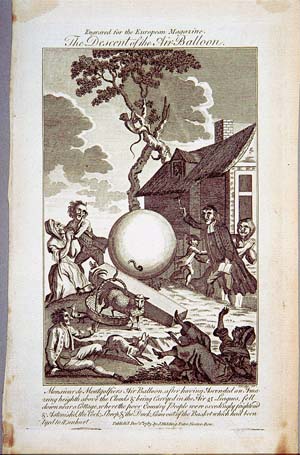
The Descent of the Air Balloon.  A cartoon representation of the sheep, duck, and cock coming out of the basket. Engraving by J. Lodge, 1783

Engraving, 17.8 x 12.7 cm.

At Versailles, on September 19, 1783, before a large crowd that included King Louis XVI of France, Étienne Montgolfier launched a balloon that contained the first air travelers—a sheep, a duck, and a rooster. The balloon rose to a height of 1,700 feet.  While it was descending, the cage containing the animals caught the branch of a tree. The door of the cage was jarred open and the animals escaped. The sheep and duck were unharmed, but the rooster had injured its wing during the journey, prompting some to question the future safety of humans in flight.

The text of the cartoon engraving seems to take no notice of the injury to the rooster: "Monsieur de Montgolfier's air balloon, after having ascended an amazing height above the clouds and being carried by the wind into the air 45 leagues, fell down near a cottage, where the poor country people were exceedingly frightened and astonished. The cock, sheep and the duck came out of the basket which had been tyed to it unhurt."


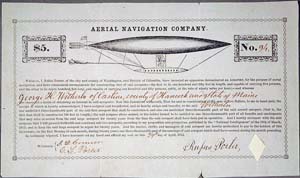
Aerial Navigation Company.  Stock certificate, April 29, 1852, Washington, D.C., issued to George H. Witherlee

Stock certificate, 12 x 20 cm.
XF-2-1 2433


Rufus Porter's career was varied to say the least.  For fifty years, after he abandoned school teaching in 1813, he was, according to Tom Crouch, in The Eagle Aloft, "a poet, dancing master, shoemaker, machinist, printer, and journalist." In 1845, he founded Scientific American. His career as an aeronautical entrepreneur, however, included the design of an "aeroport," a cigar-shaped balloon with a gondola slung underneath that would carry crew and passengers. In 1852, optimistic that he could turn his idea for the aeroport into a practical aerial conveyance, he issued stock in the Aerial Navigation Company. The Gimbel collection has certificate number 94 for $5.00, issued to George H. Witherlee of Maine.


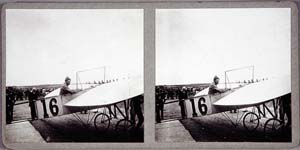
Reims Air Meet, 1909

Stereograph slides, b&w


This stereograph (photographic images designed to produce a three-dimensional effect when used with a stereoscopic viewer) of the 1909 air meet at Reims is one of forty in the Gimbel collection.


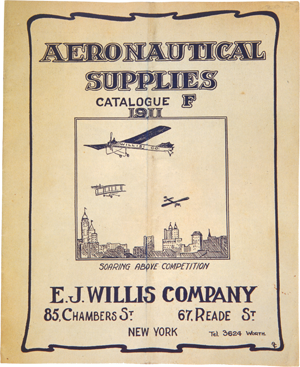
Aeronautical Supplies Catalogue  F 1911

Catalog, 18 x 22 cm.

The E.J. Willis Company, which had two locations (85 Chambers Street and 67 Reade Street) in New York City, sold aeronautical supplies of various kinds. Willis accepted only cash and C.O.D. and offered to pay transportation charges on items priced $10 or more ("exclusive of Woodwork, Oils and Greases") to places within 5 miles of New York and on items priced at $50 or more to places within 100 miles. Willis sold everything from ailerons to wheels, including aviator's apparel, and complete Blériot, Farman, or Curtiss-type aircraft.


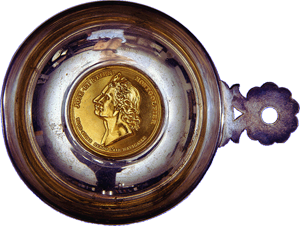
Wine Taster

The Montgolfier brothers are commemorated on the medallion enclosed in this French silver wine taster.


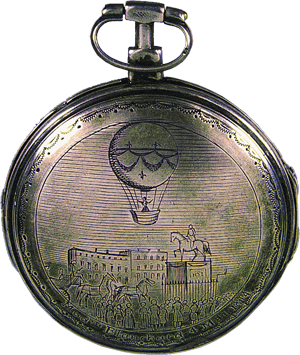
Watch

Engraving on the back of this silver watch case honors the May 4, 1814, balloon flight of Madame Marie Blanchard.


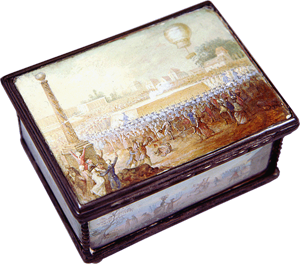
Pewter Box

Five miniature watercolor paintings adorn the top and sides of this pewter box. The largest, on the top, depicts the September 1783 Montgolfier balloon flight which carried a sheep, a duck, and a rooster.


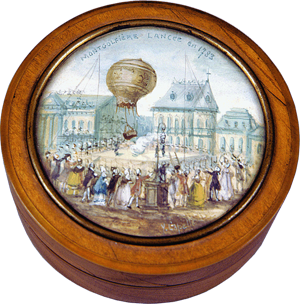
Wooden Box

The September 1783 Montgolfier balloon flight is also depicted in a capelle watercolor, mounted in an exquisitely crafted cylindrical wood box.


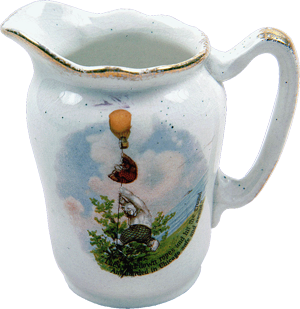
Cream Pitcher

A whimsical depiction of two bears escaping from a balloon graces this 1906 china cream pitcher. The caption reads, “They slid down ropes and hit the ground | And landed in Chicago safe and sound.”


Ornament

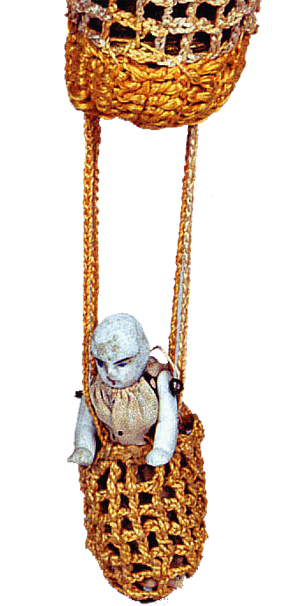
A 15 watt “Kentucky” brand light bulb was transformed into a doll-carrying balloon by an imaginative early twentieth-century crochet artist.


Cigarette Lighter

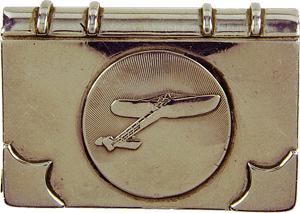
The Blériot Model X1 monoplane, in 1909 the first powered flying machine to cross the English Channel, graces this silver cigarette lighter.


China Plates (Pair)

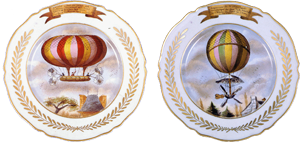
In 1840, on this rare pair of gilded china plates, the French painter, J. Siquier, captured the flights of the Robert brothers, Jean and Noel, and M. Colin; and Jean-Pierre Blanchard with Dom Péche.


Earthenware Platter

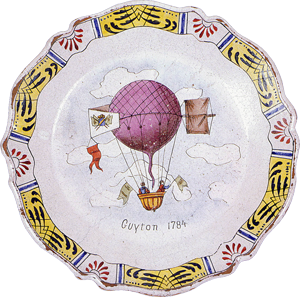
The unsuccessful 1784 attempt by Guyton de Morveau and the Abbé Bertrand to steer a balloon by the use of sails is depicted on this earthenware plate by an unknown artist.


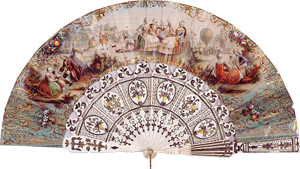
Fan

Romance and ballooning are paired on this nineteenth-century ivory and paper fan.